• Kasparov: “Trump’s deference to the Russian dictator has become full-blown imitation”

    Garry Kasparov, who witnessed the Putinization of Russia, waves a warning flag (as he did in 2017) about Donald Trump, who in his second go-round in the White House is actively siding with Vladimir Putin, as Russia faces ongoing military losses and a wobbly economy.

    Once more unto the breach arrives Donald Trump, back in office with more help from the Kremlin—and the inept Democrats—ready to throw his old pal Putin a lifeline. At his side is someone new: the richest private citizen in the world, Elon Musk. (Putin controls far more money than Musk or Trump—do not underestimate how that affects their perceptions of him as the big boss.) With Musk arrives an overused and misunderstood word in the American vernacular: oligarch.
    Although it’s not a Russian word, post-Soviet Russia popularized its use and attempted to perfect the system it described. In the 1990s, those most capable of manipulating the newly privatized markets became the richest people in Russia. They quickly seized the levers of political power to expand their resources and fortunes, persecute their rivals, and blur the lines between public and private power until they were erased.
    Putin, a nondescript technocrat, was a useful front for billionaires such as Boris Berezovsky: Putin appeared to be the hard veteran of the KGB, cleaning up corruption—while what he was really doing was bringing it inside, legitimizing it, and creating a mafia state. Oligarchs could bend the knee and profit, or resist and end up in jail or in exile, their assets ripped away.

    While Trump’s unleashing of Musk and DOGE to rip apart the infrastructure of government may not appear to fit the authoritarian model, Kasparov has seen this before:

    Cutting bureaucracy isn’t usually associated with despotism and power grabs. We tend to think of wannabe dictators packing the courts and increasing the size and power of the state. But that isn’t what you do when you want to make the government impotent against private power—your private power. The Putin model was to weaken any state institution that might defy him and to build state power back up only when he had total control.

    The world’s richest man (at least “richest private citizen”) is unelected, unaccountable, and — though he is damaging the capacity of the federal government to do its jobs — he still has his hand out. Social Security, Medicare, Medicaid, the NIH, EPA, CFPB, VA, FAA, and other programs and agencies may fail, but Musk is still near the front of the line to reap immense profits because of his connections to the Trump regime. Other billionaires aren’t far behind.

    If we continue moving in this direction, this won’t turn out well for the rest of us.

  • In revealing moment, Donald Trump displays empathy (or perhaps pity)

    Donald Trump is a narcissist, uninterested in anything and everything that does not, in his view, redound to his personal advantage or disadvantage. Insofar as other people offer him praise and admiration (expressed, best of all, by making financial payoffs), he looks on them favorably. If someone denies him such recognition, it provokes his anger. Trump is utterly indifferent to anyone who falls into neither camp.

    The president has enabled Elon Musk’s rampage through federal departments and agencies because Trump is impressed by the world’s richest man and, as the New York Times reported “[f]lattered that Mr. Musk wanted to work with him.” The president hasn’t given any thought to how the binge has affected civil servants, anyone who signed contracts that DOGE has reneged on, or folks who were to receive the goods and services that will not now arrive. Many Trump 2024 voters will be harmed by the destruction DOGE has brought. Trump, it is safe to say, hasn’t felt a pang of empathy (or pity or concern in any measure) for any of the people in harm’s way.

    Empathy is not Trump’s thing, which is why a portion of Trump’s ranting at Ukraine’s President Zelenskyy is revealing. When asked by a reporter what if Russia breaks a ceasefire, Trump responded:

    Well what if they—what if anything! What if a bomb drops on your head right now? Okay? What if they broke it? I don’t know. They broke it with Biden because Biden, they didn’t respect him, they didn’t respect Obama. They respect me.
    Let me tell you, Putin went through a hell of a lot with me. He went through a phony witch hunt where they used him and Russia—Russia, Russia, Russia, you ever hear of that deal? That was a phony
    —that was a phony Hunter Biden, Joe Biden scam. Hillary Clinton, shifty Adam Schiff, it was a Democrat scam. And he had to go through that. And he did go through it and we didn’t end up in a war. He went through it, he was accused of all that stuff—he had nothing to do with it. It came out of Hunter Biden’s bathroom. It came out of Hunter Biden’s bedroom. It was disgusting. And then they said, ‘Oh, oh, the laptop from hell was made by Russia.’ The 51 agents, the whole thing was a scam, and he had to put up with that. He was being accused of all that stuff. All I can say is this: He might’ve broken deals with Obama, and Bush, and he might’ve broken them with Biden. He did, maybe, maybe he didn’t—I don’t know what happened. But he didn’t break them with me. He wants to make a deal. I don’t know if he can make a deal.

    Trump has revealed empathic feelings toward Vladimir Putin, who Trump believes had to suffer accusations from the likes of Joe Biden, Hillary Clinton, and Adam Schiff. Trump is aggrieved on Putin’s behalf. President Trump feels President Putin’s pain — or what he is convinced is the pain Putin must feel (since Trump feels it so acutely).

    Of course, in Trump’s mind the accusations against Putin — “Russia, Russia, Russia” — are identical (and equally unfair) to the accusations against Trump. The man with overweening narcissism identifies with the Russian strongman. What he, Trump, feels, he projects onto Putin.

    OneLook defines empathy as “Identification with or understanding of the thoughts, feelings, or emotional state of another person.” Trump, in this moment of anger at his own victimhood and at Zelenskyy’s disrespect of him, is displaying something very like empathy for another human being.

    Trump is capable of this experience because he identifies with Putin. In Trump’s mind, he and Putin are both strongmen, coequals, fearless leaders of powerful countries. So, of course, since Trump-the-victim has been wounded by the accusations against him and Putin, then in the president’s mind Putin must feel the same way.

    That’s not to say that Putin actually feels the same way as Trump. Since Trump’s projection into Putin’s mind and emotions is almost certainly wrong, perhaps empathy doesn’t apply. Perhaps pity is more accurate.

    Still, this is a rare and remarkable expression of feelings for another person from our nation’s president. Unfortunately, this expression exposes Trump’s vainglorious obsession with himself and his own grievances.

  • How the resentful billionaire’s rampage wrought so much damage, so quickly

    Today’s New York Times features a report (“How Elon Musk Executed His Takeover of the Federal Bureaucracy”) on DOGE, providing detail (going back a year and a half) on the destructive effort and clarifying a bunch of stuff for which we already had ample evidence.

    In a September 2023 dinner in the Silicon Valley, “Mr. Musk made clear that he saw the gutting of that bureaucracy as primarily a technology challenge.”

    The destruction, at the hands of a bunch of computer geeks, is going full throttle.

    The team is now moving faster than many of the legal efforts to stop it, making drastic changes that could be hard to unwind even if they are ultimately constrained by the courts. Mr. Musk’s associates have pushed out workers, ignored civil service protections, torn up contracts and effectively shuttered an entire agency established by Congress: the U.S. Agency for International Development.

    When Brad Smith, another billionaire and someone who had worked with Jared Kushner and Amy Gleason (later named acting head of DOGE), advised him on government policy, Musk resisted:

    Mr. Musk expressed impatience with Mr. Smith’s caution that the team would need a phalanx of lawyers to help with executive orders and regulations. Mr. Musk wanted to tear down the government to the studs, and saw Mr. Smith’s approach as incremental.

    It has been clear from the beginning that government efficiency had nothing to do with the actions of the Department of Government Efficiency. The point was, and continues to be, destruction: to tear down the government to the studs. And Musk’s crusade has been fabulously successful thus far.

    His swift success has been fueled by the president, who handed him the hazy assignment of remaking the federal government shortly after the billionaire endorsed him last summer. Flattered that Mr. Musk wanted to work with him, Mr. Trump gave him broad leeway to design a strategy and execute it, showing little interest in the details.

    Nothing and no one has slowed things down. Trump could, but he’s all-in. So the destruction continues apace. The damage has been so indiscriminate that many people — including Trump 2024 voters — will be hurt. There will be political blowback.

    By that time, though, the damage could be immense.

  • “You don’t have the cards!” –Donald Trump to Volodymyr Zelenskyy

    The President of the United States repeated that phrase several times, as Trump and Vance — like a tag team in the ring with a single opponent — took turns berating the Ukrainian president. Trump, who clearly has the power to turn the tables on Ukraine, has sided with Putin. The United States and Russia are now partners. With the emphatic, “You don’t have the cards!” Trump is rubbing it in, underscoring that Ukraine is powerless to change the course that the president has set for the U.S.

    The president stepped in, after JD Vance chastised Zelenskyy for “trying to fight it out in the American media when you’re wrong.” And Trump got this right: “I think it’s good for the American people to see what’s going on.” Yes, and for the world. Here’s how the U.K reacted:

    NEW: The first front pages of Saturday’s newspapers in the UK.“Ukraine Hero Ambushed”“Trump stuns world with vile rant at Zelensky”“A spectacle to horrify the world”Trump is obliterating the global reputation of the US.

    News Eye (@newseye.bsky.social) 2025-02-28T22:23:31.404Z

    Other European allies will respond the same way. As will longtime American allies across the globe.

    Most Americans can be expected to respond as our allies will. Except, now that the change is clear, soon enough folks in the Republican Party will switch to Putin’s side as well. Republicans, no matter what came before or what principles they once embraced, inevitably play the parts that Trump assigns. The U.S. is on Putin’s side now.

    March 7, 2025 postscript:

    A conservative French news magazine brightening up the Paris news stands … hard to overstate the damage Trump is doing to his and USA’s reputation among allies (sic)

    Alastair Campbell (@alastaircampbell2.bsky.social) 2025-03-07T16:22:55.917Z

  • Donald Trump is “one of the most skilled propagandists in history”

    President Trump, a prodigious liar during his first term, has upped his game in his second. In a brief review, Peter Baker observes that Trump has created “a whole alternative reality to lay the groundwork for radical change as he moves aggressively to reshape America and the world.”

    Baker quotes a couple of historians on the subject:

    “We have seen repeatedly how President Trump creates his own reality to legitimate his actions and simultaneously discredit warnings about his decisions.” — Julian E. Zelizer, Princeton University; editor of The Presidency of Donald J. Trump)

    “Trump is a highly skilled narrator and propagandist. Actually he is one of the most skilled propagandists in history.” — Ruth Ben-Ghiat, New York University; author of Strongmen: Mussolini to the Present)

    Baker offers a half dozen recent examples (all familiar) of Trump’s fraudulent narratives, which serve to justify something Trump is doing or wishes to do. And Baker cites former Trump aides who have seen up close Trump’s modus operandi.

    Mr. Trump’s aides have long recognized his penchant for prevarication and either adjusted or eventually broke with him. John F. Kelly, his longest-serving White House chief of staff in his first term, has said that Mr. Trump would tell his press aides to publicly repeat something that he had just made up. When Mr. Kelly would object, saying, “but that’s not true,” Mr. Trump would say, “but it sounds good.”
    Stephanie Grisham, who served as a White House press secretary in the first term, once recalled that Mr. Trump would tell aides that “as long as you keep repeating something, it doesn’t matter what you say.” And that trickled down to the staff. “Casual dishonesty filtered through the White House as though it were in the air-conditioning system,” she wrote in her memoir.

    Every Trump associate, no matter how high or how low, breathes the same air. Whether one is a White House aide, an agency manager or staffer, a cabinet secretary or member of Congress — you must accept the deceit.

    You may be required to affirm it. Current and former officials seeking intelligence or law enforcement positions in the Trump administration have been questioned about two events — the 2020 election and the January 6 riot — featured among Trump’s favorite narratives:

    two individuals, both former officials who were being considered for positions within the intelligence community, were asked to give “yes” or “no” responses to the questions: Was Jan. 6 “an inside job?” And was the 2020 presidential election “stolen?”

    Only loyalists, ready to affirm the lies, can expect to get hired.

    Republicans must play the parts that Trump assigns. And every part is drenched in lies.

  • MAGA embrace of Alternative for Germany; soon everyone in the GOP will be on board

    The United States, at the direction of Donald Trump, has switched sides in the war Russia launched against Ukraine. Trump is partnering with Vladimir Putin. The president has attacked our European allies (and others: north and south of our border and across the globe) and NATO, the alliance that has kept the peace for three-quarters of a century.

    Embrace of AfD

    And the Trump administration has done a bear hug with the far-right Alternative for Germany (AfD) party, which has diminished the significance of Hitler and the Nazi era, thereby prompting a rejection from every other German political party.

    Elon Musk — among Trump’s closest allies — has urged Germans to “move beyond” guilt and told more than 4,000 rallying AfD supporters, “I think you really are the best hope for Germany.” Then JD Vance scolded American allies in a speech in Munich for not listening to voters “with an alternative viewpoint,” followed up by meeting with the leader of AfD, and afterward doubled down in a speech to CPAC.

    Peter Wehner, addressing the MAGA embrace of AfD writes:

    For Vance and Musk to go so far out of their way to support not just any rising radical movement, but this particular party, in this particular country, with its deep historical experiences with fascism, is quite telling. They are not just “trolling the libs”; they are giving their public backing to a movement that represents the core convictions of MAGA world. They see in the AfD an undiluted version of MAGA. What we’re witnessing from Trump & Company, as alarming as it is now, is only a way station.
    And before you know it, virtually everyone in the Republican Party will be on board. Trump always changes them; they never change him. The AfD’s approach to politics—nihilism with a touch of Nazi sympathizing—is the model.

    Yes, before you know it (no matter what came before, no matter what principles the Republican Party espoused previously), virtually everyone in the Republican Party will be on board. The men and women of this party inevitably follow their leader.

  • Elon Musk, pseudonymous accounts on X, and presidential choices

    [“This is a real picture”— Elon Musk]

    Michael Scherer, Ashley Parker, Matteo Wong, and Shane Harris at the Atlantic have a great inside look on what Musk’s raiders are up to (“This Is What Happens When the DOGE Guys Take Over“). The tech team’s approach: “Radical action was the only responsible course. The improperly fired could be rehired. The confusing memo could be withdrawn and replaced. The courts might overturn their actions, but that is a problem for another day. Make change happen, and rebuild the smashed shards later, if necessary.”

    And long before Musk convinced Trump to let him loose, Project 2025 co-author, Russell Vought, now director of OMB, explained the plan:

    Vought called for a return to a pre-Watergate mindset—“a radical constitutional perspective to be able to dismantle that bureaucracy in their power centers.” There would be three prongs of the attack, he told Tucker Carlson during a November 18 podcast.
    First, “the whole notion of an independent agency should be thrown out,” Vought said, giving the president complete control of the executive branch to impose his will. Second, the courts must be provoked to smash the idea that Congress directs spending. “Congress gets to set the ceiling. You can’t spend without a congressional appropriation, but you weren’t ever meant to be forced to spend it,” Vought said, dismissing the 1974 Impoundment Control Act, which basically decrees the opposite. Third, the protections of the civil service must end, making nearly all of the federal workforce at-will employees.
    This is where Musk entered under the banner of cost reduction, a useful side effect of the larger project. 

    Yes, cost reduction is a false flag, though “a useful side effect of the larger project” from the point of view of rich folks who don’t wish to pay taxes and disdain entitlement expenditures — except, of course, they often have outstretched hands when government is dishing out funding. (Musk’s companies have received north of $20 billion from the feds in contracts, subsidies, and tax breaks.)

    Inspired by the 500 accounts Musk follows on X

    Vought is the big picture guy. Musk and his young techies, in contrast, are just racing this way and that. Jeffrey Goldberg asks how DOGE decides which agencies to target. “This seems to be being done on the fly“– as though Musk is taking direction from accounts on X.

    Teddy Schleifer of the New York Times confirms this: “I think that’s literally true. I mean I think that Elon Musk literally is driven by the 500 people that he’s following on Twitter. … And some of these people are pseudonymous accounts.”

    “The people who — I know it sounds ridiculous. The people who Elon Musk follows on Twitter are some of the most important people in American culture.”

    Drawing on his observations during the transition, Schleifer offers evidence of the perceived influence of the 500. And he describes this scenario: one of the 500 accounts tweets something crazy and unverified; Musk responds, Interesting.

    Fine. But in the present day, one of the 500 tweets an idea … and “suddenly the democratically elected president is doing whatever that guy said was interesting.”

    Postscript

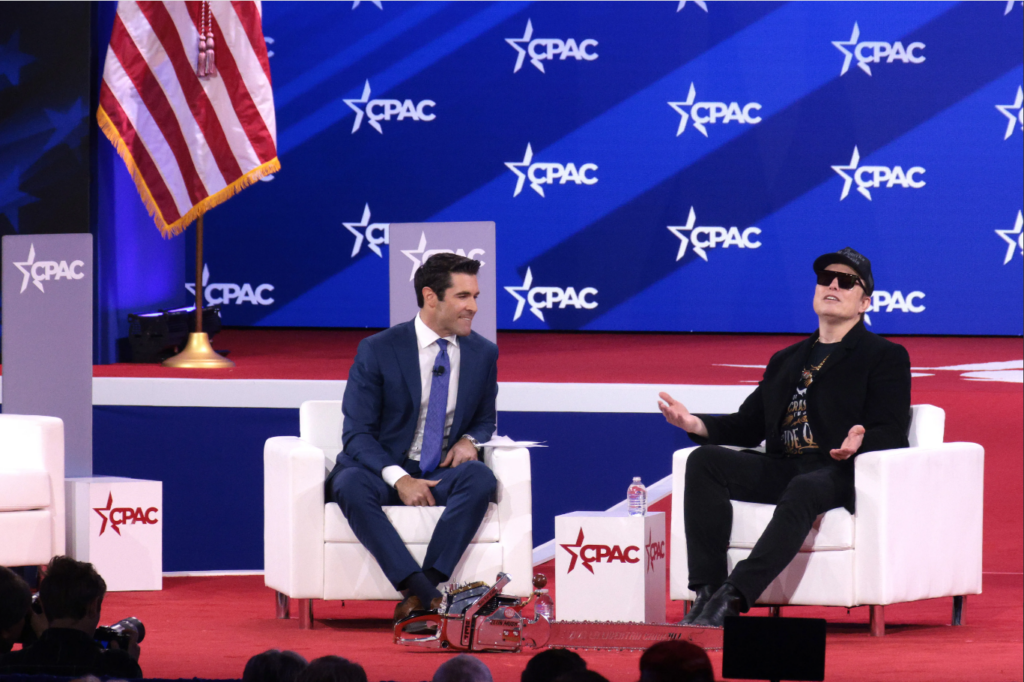
    The images in this post are of Musk at CPAC 2025. Sarah Jeong provides a transcript of “a strange and often inarticulate onstage interview” of Musk by Rob Schmitt (of Newsmax).

  • Trump meme coin is “the most brazen act of corruption of the modern presidency”

    A month ago I mentioned the Trump meme coin (“Transactional Trump continues to set records for raking in money” issued on January 17 and designed to line the pockets of Trump, his family, and his cronies.

    As of February 11, “More than 813,000 crypto wallets have lost a total of $2 billion after buying President Donald Trump’s meme coin,” while the Trump Organization and its partners have pocketed a cool $100 million in trading fees.

    But profiting off unsophisticated fans (I hesitate to say, ‘investors’) is not as significant for Trump as the backdoor the coin offers for unlimited and unseen corruption. In the words of Representative Jake Auchincloss (interviewed this week by Ezra Klein):

    Not to be too doomer about it, but Trump issued the Trump coin. And that Trump coin is the equivalent of issuing the account number for a Swiss bank account, telling foreign adversaries they can deposit funds into that account anonymously but then come and show him the receipts privately to prove that they have done so. It is the most brazen act of corruption of the modern presidency.
    And if people don’t think that the Chinese and the Saudis and the Turks and the Qataris are buying some of that coin, I think they are deeply naive.

    Watch closely over the next few weeks and months for changes in public policy directed by Trump to enrich savvy investors (who make money from folks less savvy) behind various cryptocurrencies. The house always wins.

    Moreover, because transactions are conducted in secrecy, and Trump is unlikely to permit federal oversight or regulation of the cryptocurrency, bribes from crooked Americans seeking favors and foreigners seeking to corruptly influence U.S. foreign policy will be hidden from view.

  • Europe challenges Trump-Putin Axis, but Senate Republicans are fine with it

    Credit a headline in Le Monde for christening the alliance that has introduced a new world order, though perhaps Putin-Trump Axis would be more apt, since Trump inevitably bends a knee to Putin.

    Trump has initiated negotiations with Russia, excluding Europeans and Ukrainians, to end the war started with Russia’s invasion of Ukraine.

    You should have never started it. You could have made a deal,” President Trump said of Ukraine’s leaders. He went on to call President Volodymyr Zelenskyy “a Dictator without Elections.”

    Dismissing the threat to our European allies, Trump has pledged a U.S. partnership with Russia.

    Meanwhile, back home, Republicans have abandoned decades embracing a strong national defense, while opposing the U.S.S.R. and then Russia. Now Republican Senators have changed their tunes or held their tongues.

    This shameful, foolish alliance that will damage our country’s security is not just Trump’s policy. This is the foreign policy of the contemporary Republican Party. The ‘serious’ Republican senators (and a smaller sample of House Republicans) we’ve read about in recent years, who put national security issues above partisan politics — they have switched sides or they lack the courage of their convictions.

    This is their policy. They can’t escape it. Trump’s siding with Vladimir Putin and pushing away our allies is the foreign policy position of the Republican Party.

  • The courts will not stop Trump and Musk from trashing the federal government

    Elon Musk – enabled by Donald Trump – is, as I’ve argued, on a tear to destroy the capacity of the federal government, through mass firings and agency shutdowns, to do what Americans expect of it. Beginning with USAID and the CFPB, the Trump administration is on the way to radically redirecting federal policy on immigration, climate, energy, tariffs, DEI and civil rights more broadly (most prominently: gender and transgender rights), health, science, education, consumer protection, and more.

    In this post I argue that the courts will not stop Musk and DOGE.

    Court challenges

    First of all, these activities are unfolding according to plan — as designed by Project 2025. Democracy Docket quoted Jacqueline Simon, the public policy director of the  American Federation of Government Employees (AFGE),  on November 19, 2024:

    Repeatedly throughout the Project 2025 chapters, they say to just move forward, go ahead and implement and worry about defending it in court later. Expect legal challenges, because they know what they’re doing is unlawful.

    Other Trump opponents agree that the whirlwind of executive orders is unlawful, which has resulted in a blizzard of lawsuits to put a stop to the wanton destruction. (As of February 19, LAWFARE  had identified more than fifty legal challenges to President Trump’s executive orders.)

    Fox News legal analyst Jonathan Turley, on the other hand, is convinced that the administration holds strong cards in this battle. Asked by Brian Kilmeade about a conflict between the State of New York and Trump’s Department of Justice regarding immigration enforcement, Turley addressed the broader Trump strategy:

    The interesting thing about this effort is it’s part of an overall effort to get these issues into court, get judicial review, establish what the navigational beacons are and going forward. I like that, because this is an administration on a mission. They want to not waste all the time that they saw just burn away in the first term and instead hit the ground running. So they’ve gone on this sort of full assault across the board. They’re virtually inviting people to take them to court and they also have strong arguments.

    I am confident that whatever successes Trump’s critics achieve in court, they will not end Musk’s reckless crusade. The judiciary may nickel and dime  Trump or Musk or Russell Vought on this or that — requiring shifting or recalibrating — but don’t expect nearly enough push back to halt the ongoing demolition.

    Design matters

    Never mind the great expansion of executive power in the half century since the Nixon era, when we were talking about the Imperial Presidency. Never mind that Congress has willingly acceded power over time to the chief executive. The reason Trump will win the most significant cases in court is because the laws were not designed for the present scenario, as illustrated in Lisa Rein’s illuminating “As Musk reshapes the government, some ask: Where are the guardrails?” in the Washington Post.

    Both Congress (in passing legislation) and previous presidential administrations (in their rulemaking) “simply never envisaged” a president acting as recklessly, corruptly, and foolishly as Donald Trump has.

    Here’s my quick and dirty summary of Rein’s review:

    First, much of the most reckless conduct is not prohibited by law – it is within the president’s prerogative. Often statutory or regulatory prohibitions are aimed at other actors, not at a president. This is because Congress “simply never envisaged” a president acting as Trump, or the folks he has enabled, are doing.

    “We’re at a point where things are so unprecedented that it’s not even close to what was envisioned by any of the statutes that exist,” said Nick Bednar, a professor at the University of Minnesota Law School who specializes in the civil service. “We do have guardrails. But they assume moderately bad behavior. They don’t assume complete efforts to assault the traditional institutions of government.”

    What’s true of legislation is true as well of rulemaking within the executive branch.  Cybercrimes and privacy laws focus on rogue personnel in government or foreign agents, not on the president, who has wide discretion to act.

    Furthermore, the Project 2025 folks have identified rules that “never accounted for the manner in which this White House would use them.” An example: Congress granted presidents authority to hire “special government employees” – to assist in finding the right person for “hard-to-fill jobs, for example in science, technology and engineering.”

    Congress did not foresee a billionaire, with conflicts of interest galore and egged on by thousands of fanboys on X, running rampant within the executive branch. And no matter how much we might object to DOGE acquiring sensitive information from federal departments and agencies, the president or his “cabinet secretaries – even acting ones” have the legal authority to permit this.

    Further, “Trump officials have found ways to use old laws to their advantage to enact massive changes to the government that Congress did not anticipate when it enacted the post-Watergate civil service law in 1978.” The administration has repurposed that law, which allowed a president to exempt individuals from civil service protections and waive certain hiring procedures, to do something Congress never intended: reclassifying tens of thousands of civil servants – the easier to boot them out and replace them with partisan loyalists.

    In each case, Congress passed legislation granting presidents broad authority; this president is acting on that authority in ways unimagined before Trump.

    Finally, “Musk and his team have also taken advantage of legal bulwarks with unclear or weak enforcement standards.” In other words, even if they violate the law, in some instances there’s not much anyone can do about it.

    Of course, the Supreme Court has the final say regarding judicial decisions, but the current supermajority is hardly prepared to block the wild Musk rampage.

    The Roberts Court 

    The Republican majority on the Supreme Court ran roughshod over the Constitution to grant presidents immunity from criminal prosecution for laws intended to apply to everyone. This court will not stop Trump from his campaign of destruction, which no Republican dares question publicly.

    Let’s first review what the Roberts Court ruled in Trump v. United States. Justice Sonia Sotomayer’s dissent clearly and crisply described the majority decision. In three brief passages:

    Today’s decision to grant former Presidents criminal immunity reshapes the institution of the Presidency. It makes a mockery of the principle, foundational to our Constitution and system of Government, that no man is above the law.
    Relying on little more than its own misguided wisdom about the need for “bold and unhesitating action” by the President, ante, at 3, 13, the Court gives former President Trump all the immunity he asked for and more. Because our Constitution does not shield a former President from answering for criminal and treasonous acts, I dissent.

    . . .

    Setting aside this evidence, the majority announces that former Presidents are “absolute[ly],” or “at least . . . presumptive[ly],” immune from criminal prosecution for all of their official acts. Ante, at 14 (emphasis omitted). The majority purports to keep us in suspense as to whether this11Cite as: 603 U. S. ____ (2024) immunity is absolute or presumptive, but it quickly gives up the game. It explains that, “[a]t a minimum, the President must . . . be immune from prosecution for an official act unless the Government can show that applying a criminal prohibition to that act would pose no ‘dangers of intrusion on the authority and functions of the Executive Branch.’ ” Ibid. (emphasis added). No dangers, none at all.
    It is hard to imagine a criminal prosecution for a President’s official acts that would pose no dangers of intrusion on Presidential authority in the majority’s eyes.

    . . .

    Looking beyond the fate of this particular prosecution, the long-term consequences of today’s decision are stark. The Court effectively creates a law-free zone around the President, upsetting the status quo that has existed since the Founding. This new official-acts immunity now “lies about like a loaded weapon” for any President that wishes to place his own interests, his own political survival, or his own financial gain, above the interests of the Nation. Korematsu v. United States, 323 U. S. 214, 246 (1944) (Jackson, J., dissenting). The President of the United States is the most powerful person in the country, and possibly the world. When he uses his official powers in any way, under the majority’s reasoning, he now will be insulated from criminal prosecution. Orders the Navy’s Seal Team 6 to assassinate a political rival? Immune. Organizes a military coup to hold onto power? Immune. Takes a bribe in exchange for a pardon? Immune. Immune, immune, immune.
    Let the President violate the law, let him exploit the trappings of his office for personal gain, let him use his official power for evil ends. Because if he knew that he may one day face liability for breaking the law, he might not be as bold and fearless as we would like him to be. That is the majority’s message today.
    Even if these nightmare scenarios never play out, and I pray they never do, the damage has been done. The relationship between the President and the people he serves has shifted irrevocably. In every use of official power, the President is now a king above the law.

    Donald Trump, via his special government employee Elon Musk, is engaged in “bold and unhesitating action.” This is what the Republican majority sought to preserve in its off-the-rails immunity decision. This is, for the partisan Republican majority on the court, reason to celebrate.

    It is preposterous to think that the Roberts Court, after giving Trump immunity from criminal prosecution — including for ordering the nation’s military to assassinate a political rival — would stand in the way of mass purges of civil servants and shuttering departments and agencies. That’s a nonstarter.

    The administration’s Trump card

    A few words on defying the judiciary: In September 2021, JD Vance offered advice to Donald Trump (anticipating his 2024 election):

    I think that what Trump should do – like, if I was giving him one piece of advice – fire every single mid-level bureaucrat, every civil servant in the administrative state, replace them with our people. And when the courts – ’cause you will get taken to court – and then when the courts stop you, stand before the country, like Andrew Jackson did, and say, “The chief justice has made his ruling, now let him enforce it.”

    More recently Vice President Vance and Elon Musk have both challenged judicial authority over the executive branch. So has Trump himself: “But judges should be ruling. They shouldn’t be dictating what you’re supposed to be doing. And why is somebody saying that you’re not allowed to?”

    Some commentators have suggested that Chief Justice John Roberts would be certain to rule against Trump were the president to openly flout a judicial ruling. Roberts would assert, so say these observers, the authority of the judicial branch. But I believe this presumption fails to account for a trump card that the president holds.

    Trump is a master of the politics of domination and ritual humiliation. The public spectacle of DOJ dropping the prosecution of Eric Adams, which resulted in more casualties than the Saturday Night Massacre, is instructive. The quid pro quo was thoroughly corrupt, while the stakes, with a mayor whose term will end in a matter of months, were much lower than in the Nixon case.

    The Adams episode was thoroughly brazen. Just like the January 6 pardons of the criminals who attacked the Capitol police. Just like the Pete Hegseth, Kash Patel, Tulsi Gabbard, and Robert Kennedy nominations; the pivot to what Europeans have dubbed the Trump-Putin Axis; the Big Lie that Trump won the 2020 presidential election. And just like, of course, Musk’s butchery of infrastructure at the heart of the government of the United States.

    Trump is accustomed to getting his way. Loyalty to him is paramount. Defiance is costly.

    The lesson for Roberts: don’t get in Trump’s way. The president would delight in humiliating the judicial branch, just as he has the legislative branch. It would send a powerful signal. It would raise the president’s popularity among the base of the Republican Party (which the five men on the Roberts Court have served faithfully throughout their careers). It would wound the Supreme Court.

    Furthermore, if Trump were to defy the Supreme Court, this might backfire on the Republican Party.

    Roberts, if he wishes to avoid humiliation (and not disadvantage the GOP), may erect feeble roadblocks (which will invite workarounds) to Trump, but the Supreme Court will not rule against Trump when the stakes are high.