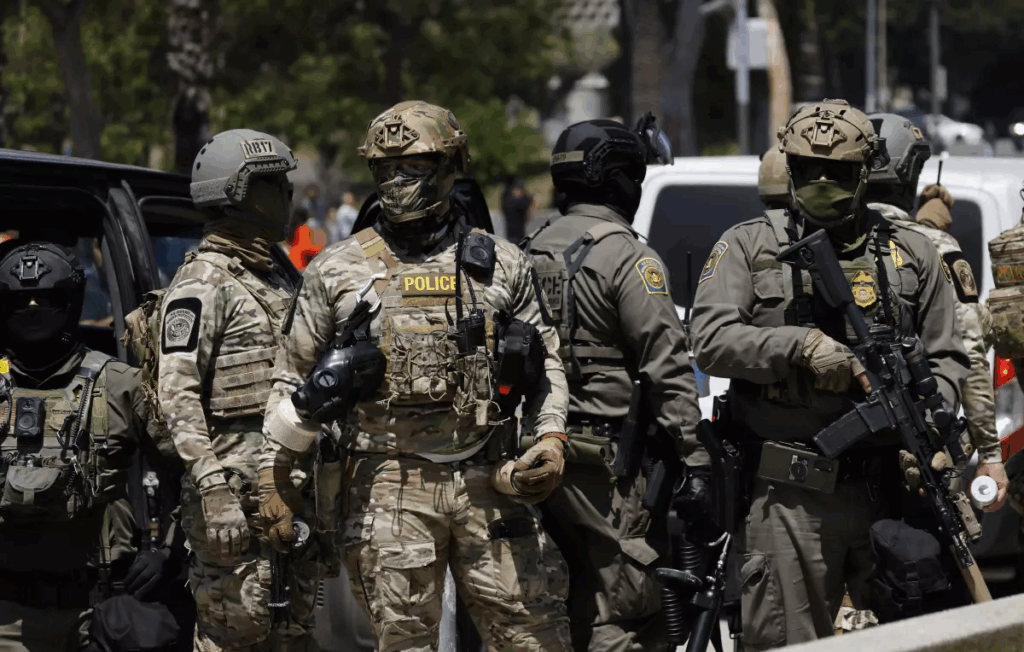
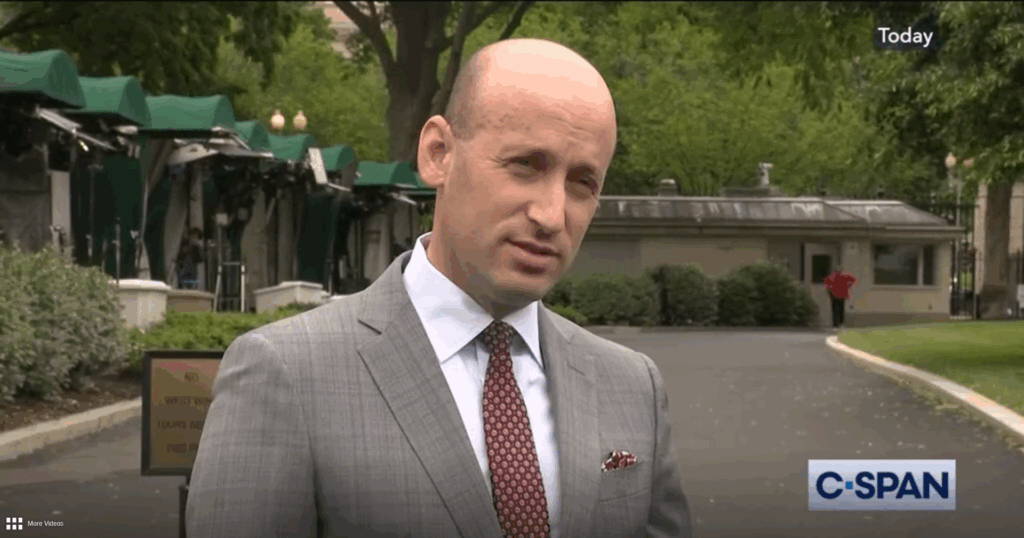
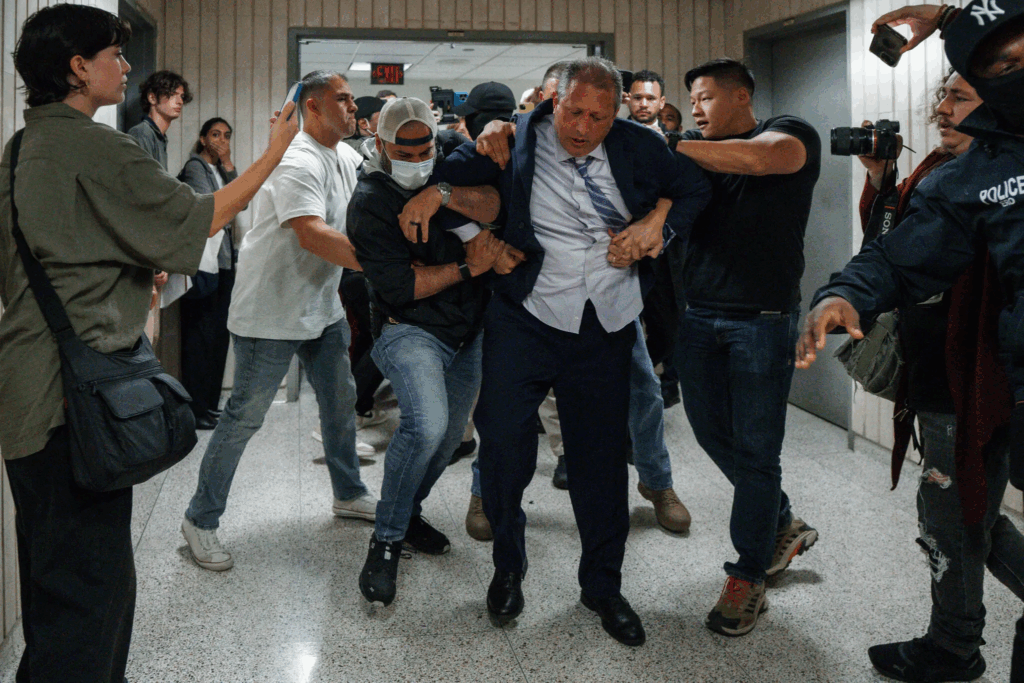
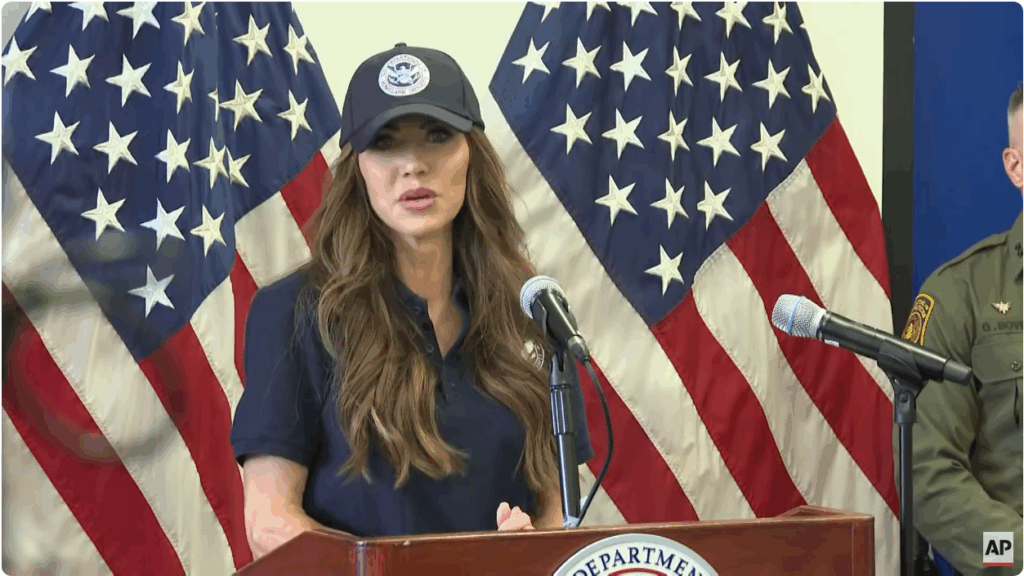
• Trump’s weaponization of law enforcement in action

    For my friends, everything; for my enemies, the law.

    Trump’s presidency has seen this credo play out with elected officials (and others) of both parties, mostly Republican friends on the one hand and Democratic enemies on the other.

    Enemies

    Let’s begin with the enemies. “I am your retribution,” Trump pledged during his 2024 campaign.

    U.S. Senator Alex Padilla of California was forcibly removed from a Kristi Noem press conference last week:

    New York City Comptroller (and candidate for mayor) Brad Lander was arrested at an immigration courthouse yesterday — by men, some masked, without any uniforms or visible badges:

    In each case, there was a theatrical show of force. This, for the pleasure of Fox News Channel (and conservative media), Twitter trolls, and the MAGA base. And — of course — to intimidate the ‘enemy’ camp.

    Less prominent political enemies who have found themselves targeted by the Trump 2 administration are mostly Democrats, but include Republicans who have displeased Trump.

    In April 2025, Trump directed DOJ to investigate Miles Taylor and Chris Krebs., who both served in the first Trump administration, but who have become critics. The next day, the U.S. attorney announced investigations of both the governor and the attorney general of New Jersey. So far, in the first five months of Trump’s second term, more than 100 perceived enemies have been targeted by federal officials doing his bidding.

    Trump has grabbed the authority to govern from California Governor Kevin Newsom and Los Angeles Mayor Karen Bass, both of whom are in place because they won elections. After Trump’s border czar threatened to arrest Newsom, Trump endorsed the idea. The grounds for arrest? Trump: “I think his primary crime is running for governor because he’s done such a bad job.

    Trump has also targeted law firms and prominent universities, with clients or constituents viewed as enemies of MAGA. And, of course, hundreds of immigrants in Democratic cities and states have been detained and many have already been deported.

    Friends

    Second, Trump’s friends — who have received pardons and commutations:

    More than 1,500 so far in the first half of 2025. That total includes the January 6 crew, including Trump supporters who brutalized police officers, men convicted of seditious conspiracy, and a slew of men with felony convictions in their past.

    Seven federal elected officials and nine state and local officials — convicted of corruption, ranging from bribery, fraud, acting as a foreign agent, and insider trading — received pardons or commutations from Trump. Some of these crooks had already served their prison sentences, but eight of them dodged roughly 50 years of prison time collectively. In addition, a couple of miscreants, including Democratic NYC Mayor Eric Adams (who attended Trump’s inauguration), were let off the hook before prosecution. Trump has also let several drug kingpins off.

    The pattern is so obvious that convicted felons have begun “modeling themselves after Trump to increase their chances of winning his favor.” Politico reports:

    After Trump pardoned his longtime supporter and former Virginia sheriff, Scott Jenkins, of conspiracy to commit bribery at the end of May, the Department of Justice pardon attorney, Ed Martin, took to X to make clear the administration’s priorities: “No MAGA left behind.”

    We’re not quite halfway through Trump’s first year back in the White House. What he is dishing out is hardly justice. It’s exactly what Trump promised: retribution.

    The Republicans in the majority of both houses of Congress haven’t moved to put a stop to it, while the Republican majority on the Roberts Court has egged on Trump’s authoritarian binge by siding with him, and against the Constitution, in a string of key decisions.

    Welcome to government by and for the contemporary Republican Party. And against the rest of us.

  • Trump’s military intervention overthrows the will of the California electorate

    [Kristi Noem press conference in Los Angeles, June 12, 2025]

    “The Department of Homeland Security and the officers and the agencies and the departments and the military people that are working on this operation will continue to sustain and increase our operations in this city.
    We are not going away. We are staying here to liberate the city from the socialists and the burdensome leadership that this governor and that this mayor have placed on this country and what they have tried to insert into the city.” — Secretary of Homeland Security Kristi Noem

    Governor Gavin Newsom and Mayor Karen Bass are leading the State of California and the City of Los Angeles because they won free and fair elections to do so.

    Besmirching these leaders or using cute appeals to liberation to serve political ends hardly justifies — under our Constitution — military rule imposed by a president. The authority of state governments hasn’t vanished because we have a wannabe strongman in the White House. The Constitution places limits on the federal government and on presidents.

    Note: I’m not an attorney, much less a legal scholar. It may well be in this instance that this president is acting within the strict rule of law (as authorized by past Congresses, which took for granted that future presidents would act with good faith, respect for our democratic institutions, and a commitment above all else to furthering the national interest for all Americans). But the big picture is clear enough for all who care to see it: this president and the contemporary Republican Party (which dominates all three branches of the federal government) are pushing hard to create an authoritarian regime in the United States of America.

    Donald Trump made clear during his campaign in 2024 that he intended to crack down on his political opponents. His immigration crusade in the biggest blue state of all creates fear, disrupts lives, and damages the economy. He is deliberately, with malice aforethought ripping power away from leaders elected by voters who disfavor this president and his agenda.

    In 2021, Trump sought to overthrow the results of an election. That was without precedent at the time. Then it became a thing in the MAGA GOP (from Arizona’s Kari Lake to North Carolina’s Jefferson Griffin). Increasingly, when Republicans lose an election they declare it rigged. Americans can no longer rely on both parties to accept election outcomes and peaceful transfers of power.

    Trump created the big lie that he won in 2020. MAGA and rightwing media have kept this shameful lie alive in order to generate anger in the GOP base and to justify whatever power grab Republicans can cook up. Project 2025 was a grand scheme to cook up as much as possible, which the Trump 2 administration is intent on implementing.

    Now, without bothering to manufacture a big lie about California elections, Trump has simply grabbed power from the undisputed election winners in a blue state and a blue city — and employed the nation’s military in doing so. This too, until this month, was unprecedented in a democratic United States.

    Trump’s actions in Los Angeles represent an attack on our democracy. Arbitrary rule without accountability is why Americans fought the Revolutionary War. The United States Constitution exists to secure our freedom from tyranny.

    No Kings!

  • Donald Trump is itching for a violent spectacle

    By now it’s abundantly clear that the Trump 2 administration/Project 2025/MAGA GOP’s chief aim is to push presidential power past constitutional and legal limits (as generally accepted, certainly prior to 2016, by constitutional scholars across the political spectrum). From the DOGE wrecking ball, to the attacks on universities and law firms, to masked agents in tactical gear making arrests on the street, to deportations to foreign prisons, to stonewalling the courts, to open self-dealing on a massive scale: almost all of this has been lawless, though facilitated by the Roberts Court’s 2024Trump v. United States, which championed a “bold and unhesitating” chieftain and exempted him and him alone from the rule of law.

    Donald Trump has been eager to employ military forces against Americans who oppose him and his policies since at least the summer of 2020. The then first-term president was enraged by the Black Lives Matter protests. He wanted to deploy 10,000 active duty troops to clamp down on the protesters. His then Defense Secretary relates that Trump asked the Chairman of the Joint Chiefs of Staff, Can’t you just shoot them in the legs or something?

    More recently, during his 2024 campaign, Trump mused about employing the military to reign in his political enemies. When asked by Maria Bartiromo last October about his concerns about chaos on election day, Trump responded:

    I think the bigger problem is the enemy from within, not even the people that have come in and destroying our country and by the way, totally destroying our country. The towns, the villages, they’re being inundated.
    But I don’t think they have the problem in terms of Election Day. I think the bigger problem are the people from within. We have some very bad people. We have some sick people, radical left lunatics. And I think — and it should be very easily handled by, if necessary, by National Guard or, if really necessary, by the military, because they can’t let that happen.

    He’s clearly thinking about political opponents. That same week, Trump referenced then-Congressman, now Senator Adam Schiff as “the enemy from within.”

    January 6, 2021 — United States Capitol

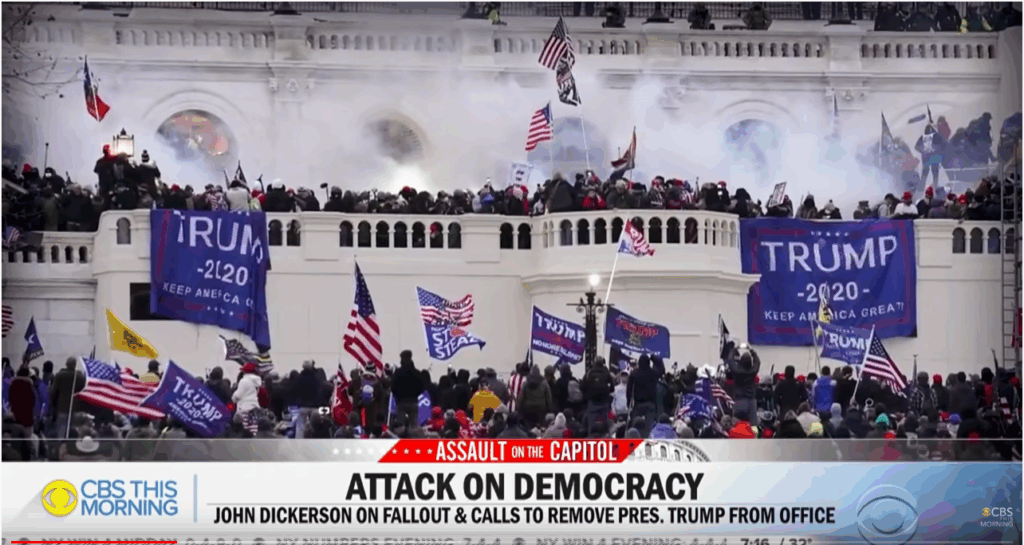
    Let’s recall: On January 6, 2021 Donald Trump declined to call out the national guard when the folks that he had summoned to the Capitol viciously assaulted police officers, injuring 140 of them (while one officer, who rioters had pepper-sprayed, collapsed and died hours later); broke through doors, windows, and barricades to enter the building; trashed and vandalized offices; and threatened the safety of the Vice President, members of both branches of Congress, and their staffs. The second-term president followed up by pardoning the whole lot, including the most violent among them (including the more than 500 convicted of assaulting or interfering with police officers). Five Proud Boys — Enrique Tarrio, Zachary Rehl, Ethan Nordean, Joseph Biggs and Dominic Pezzola, in recognition of the new regime, have filed a $100 million suit against the federal government. Four of these five men were convicted of seditious conspiracy.

    The President approves of violence when it serves his interests.

    June 6, 2025 — Los Angeles, California

    Homeland Security and ICE agents conducting immigration raids arrested a reported 44 people at a Home Depot in Paramount (a small city south of downtown Los Angeles) and a business in the city’s Fashion District. Peaceful protesters gathered, including more than a hundred by early evening at the Metropolitan Detention Center (near the Federal Building) downtown. But by 7:00 p.m. crowds clashed with the LAPD, which declared an unlawful assembly. Violent clashes amid protests ensued in Paramount into Saturday morning and, that evening, in downtown L.A.

    Agitators (often masked and hooded) threw rocks, bottles, and fireworks at officers (then ducked into hiding amidst the protesters). These criminals set cars afire, graffitied buildings, and looted businesses. Police responded in force with an arsenal that included rubber bullets, tear gas, and flash bangs to disperse crowds.

    The scope of civil unrest, while deplorable, has thus far been minimal. The Los Angeles Police Department and Los Angeles County Sheriff’s Department did not reach out to the Governor for additional resources (though he has subsequently sent the California Highway Patrol to assist in keeping open the 101 freeway, which travels through downtown). Local law enforcement was well prepared to handle things.

    Trump had other ideas.

    On Saturday, Donald Trump issued a presidential memorandum nationalizing 2,000 members of the California National Guard. He did so without even consulting Governor Gavin Newsom. The last time a president federalized a state’s Guard without the consent of a governor was in 1965, when the President Lyndon Johnson did so to protect protesters marching from Selma to Montgomery for voting rights. Alabama Governor George Wallace opposed voting rights for Black folks and refused to ensure the peaceful marchers’ protection.

    Insurrection

    “Insurrection.” That’s the lie — from the White House’s point man for dispensing cruelty (most especially to people of every color but white), Deputy Chief of Staff Stephen Miller — that serves as the MAGA rationale for the deployment.

    Last month the Washington Examiner offered an account of Miller’s hand in directing the mass deportations:

    ICE’s top 50 field officials were given roughly a week’s notice of an emergency meeting in Washington.
    ICE’s 25 Enforcement Removal Operations, or ERO, field office directors and 25 Homeland Security Investigations, or HSI, special agents in charge flew into Washington and descended on the agency’s Washington headquarters last Tuesday, May 20. There, they were met by Miller, ICE confirmed to the Washington Examiner.
    “Miller came in there and eviscerated everyone. ‘You guys aren’t doing a good job. You’re horrible leaders.’ He just ripped into everybody. He had nothing positive to say about anybody, shot morale down,” said the first official, who spoke with those in the room that day.
    “Stephen Miller wants everybody arrested. ‘Why aren’t you at Home Depot? Why aren’t you at 7-Eleven?’” the official recited.

    The actual on the ground tactics belie Homeland Security’s claim to be focusing on “the worst of the worst illegal alien criminals.” This regime is targeting folks — including residents here legally — in a host of peaceful places (neighborhoods, schools, immigration centers, courtrooms, Home Depots …) This brings the arrest and detention count nearer to Miller’s 3,000/day quota — but it’s far, far from the criminals, murderers, and drug smugglers that Trump promised to protect us from.

    Kristi Noem, the cosplaying Homeland Security Secretary, defended the decision to federalize the troops by trashing Gavin Newsom: “Governor Newsom has proven that he makes bad decisions. The President knows that he makes bad decisions…,” as if a policy disagreement — absent an emergency or a governor’s defiance of the constitution and the rule of law — could justify federal military force against the authority of a state of the union. (Nothing Noem utters should be taken at face value.)

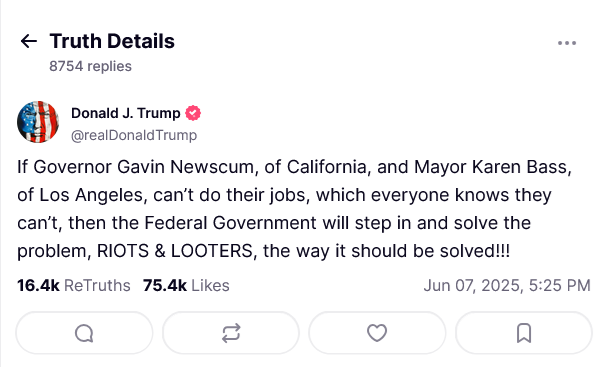
    Donald Trump weighed in repeatedly on Truth Social, inveighing against Governor Newscum and Mayor Bass, who “can’t do their jobs,” while pledging to do so to “solve the problem, RIOTS & LOOTERS.”

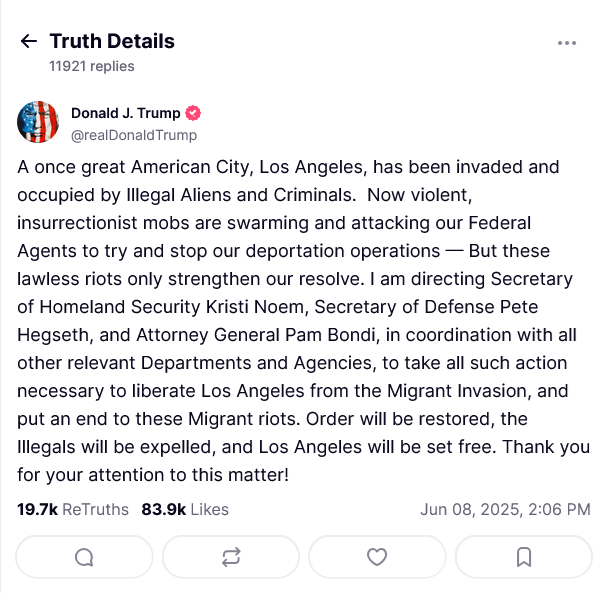
    The President lamented, “A once great American city, Los Angeles, has been invaded and occupied by Illegal Aliens and Criminals.”

    More from Truth Social: The celebration of military power: “Looking really bad in L.A. BRING IN THE TROOPS!!!” The deranged fabrication: “Paid Insurrectionists!” The grandiose: “We made a great decision in sending the National Guard to deal with the violent, instigated riots in California. If we had not done so, Los Angeles would have been completely obliterated.…”

    Presidential incitement of violence

    The grounds, the actual state of affairs through the weekend, for Trump’s actions were flimsy. The stated rationale and defenses offered are fraudulent; the bad faith is transparent. The thuggish campaign against immigrants that we have seen unfold in all its ugliness over several months instills fear and inflicts pain by design. It creates a spectacle (which celebrity Trump ally, an embedded Dr. Phil, given an ‘exclusive,’ will profit from). Fox News, trumpeting “the Los Angeles riots,” has had a field day boosting Trump’s pretend crisis (before his intervention).

    Last Friday and Saturday, when there was inevitable pushback — overwhelmingly with peaceful protest — against the indiscriminate immigration raids, the Trump administration leapt at the modicum of vandalism and violence experienced as a pretext for grasping power from a blue state governor, federalizing the National Guard, and on Monday sending in the Marines.

    The United States Marines!

    The Constitution and democracy are at stake.

    Trump does not respect democratic debate. He cannot tolerate dissent. When speaking about the military parade –“It’s going to be an amazing day. We have tanks. We have planes. We have all sorts of things. And I think it’s going to be great.” — that his administration will stage on his birthday, the President brought up (without being asked) the possibility of protest:

    “If there’s any protester that wants to come out, they will be met with very big force. For those people that want to protest, they’re going to be met with very big force.
    And I haven’t even heard about a protest, but, you know, this is people that hate our country. But they will be met with very heavy force.”

    The First Amendment be damned. Political dissent must be suppressed. Trump disparages Americans who disagree with him and the Project 2025/MAGA GOP agenda. They “are people that hate our country.”

    The United Sates of America is experiencing firsthand an authoritarian campaign to diminish our freedom and damage our democracy. Force and fear are Trump’s tools of choice.

    This is straight out of the authoritarian handbook:

    For social scientists who study the intersection of protests, politics and law enforcement, the scenes unfolding in California broadly follow a script that has played out many times in many other countries. A strong government response to demonstrations that initially start peacefully, they say, often produce increasingly violent confrontations. In some instances, they add, leaders have used the prospect of civil unrest to use heavy-handed tactics or create pretexts to expand their grip on power.

    The Trump White House is eager to grasp another fig leaf of a pretext to go even further in its power grab. It craves a violent confrontation, which city and state authorities are doing their best to ward off. Trump’s actions have escalated the situation, rather than calmed things down. Deliberately. That’s not law and order; this is an authoritarian assault directed at political enemies and at constraints on a rogue White House.

    Even if Trump doesn’t get the explosion of violence he is egging on, and the fig leaf of a plausible excuse for violent suppression by the military, he has already damaged the Constitution, federalism, state sovereignty, checks and balances, and the rule of law.

    This rampage — even if this round ends peacefully — will continue and won’t be confined to California. The Trump 2 administration has four-years to impose its will on the nation.

  • Performative politics to please the base and disparage the rest of us

    1. The White House hosted travel industry executives to a briefing on planning for the 2026 World Cup. VP JD Vance offered a welcome:

    “We’ll have visitors from close to 100 countries — we want them to come, we want them to celebrate, we want them to watch the games. But when the time is up, they’ll have to go home. Otherwise, they’ll have to talk to Secretary Noem,” Vance said, referring to the Homeland Security secretary and head of border enforcement.

    The news report suggests that Vance’s remarks, “while taken in jest, fell flat.”

    Let’s put the joke in context:

    A British backpacker. A Harvard researcher. A Canadian actress. An Australian mixed martial arts coach. Dozens of international college students.
    The Trump administration’s sweeping immigration-and-visa crackdown has begun ensnaring a class of people long-accustomed to being welcomed with open arms into the United States.

    Canada, Germany, the UK, Ireland, The Netherlands, Denmark, and Finland have all issued travel advisories as a result of the detentions of their citizens.

    But, no harm, no foul, right? Vance was just joking after all.

    2. Senator Joni Ernst, responded dismissively to constituents’ concerns about Medicaid cuts, “Well, we are all going to die. For heaven’s sakes, folks.”

    The next day she offered a sarcastic retort on social media, “I would like to take this opportunity to sincerely apologize for a statement that I made yesterday at my town hall.” The Senator explained that at her town hall,

    a woman who was extremely distraught screamed out from the back corner of the auditorium, ‘People are going to die.’
    I made an incorrect assumption that everyone in the auditorium understood that yes, we are all going to perish from this Earth. So, I apologize.
    And I’m really, really glad that I did not have to bring up the subject of the tooth fairy as well. But for those that would like to see eternal and everlasting life, I encourage you to embrace my lord and savior, Jesus Christ.

    In addition to offering scorn for her constituents, Ernst’s appeal to her “lord and savior, Jesus Christ,” appears to be part and parcel of facetious trolling (following reference to the tooth fairy), not exactly a sincere testimony of her faith. But that’s par for the course, isn’t it? She certainly wouldn’t let the message of the Gospel get in the way of denying medical care to her constituents.

    3. ICE and Homeland Security, seeking workers who may have lacked documentation, served warrants at two popular restaurants in the South Park neighborhood of San Diego on Friday. Four people were taken into custody at the worksite.

    Tensions remain high” in the aftermath according to the Los Angeles Times:

    “This was an unnecessary and alarming show of force deployed by those federal agents at a restaurant in a residential neighborhood,” Councilmember Stephen Whitburn, whose district includes South Park, told The Times. “Setting aside the debate over immigration policy, I would like to know the justification for sending dozens of agents, wearing masks, carrying machine guns and handcuffing all the workers to execute a warrant for somebody who might be undocumented. Are you serious?”

    Is there another democratic country in the world where this would take place?

    The White House’s Stephen Miller responded as expected — with outright lies:

    We are living in the age of leftwing domestic terrorism. They are openly encouraging violence against law enforcement to aid and abet the invasion of America.

    There was an age — during the height of the LBJ’s and Nixon’s War in Vietnam — of “leftwing domestic terrorism” in the country. But this ain’t the age of the Weather Underground, nor are animal rights or environmental radicals on the left ascendant today.

    In the 21st century, white supremacists, anti-Muslims, and anti-government extremists on the right have become far and away the greatest source of domestic terrorist violence in the U.S. And there is ample evidence that it’s not even a close call, not in recent years. The most significant terrorist threats to Americans by other Americans come from the right.

    Donald Trump has celebrated violence repeatedly. And he began his second term with pardons for the January 6 rioters, including those convicted of violence against the police (as well as of seditious conspiracy.) That counts as open encouragement of violence against law enforcement. Miller’s “they” doesn’t specify a single Democrat (or any leftwing figure) of prominence who comes close to Trump in either rhetoric or action that encourages violence against the police.

    And there is no invasion of the country. That’s another lie.

    Finally, the masked agents who refuse to identify themselves, the staged arrests at various venues, militarized assaults on immigrants and Americans alike (as in the restaurant kitchens), the deportations to foreign prisons: these are all contrived to troll, to taunt, to intimidate, to create fear, to punish. And this campaign is directed more at Americans who oppose Trump politically (or may be tempted to oppose), than at any criminal element in the country.

    Add the pardons (after those of the January 6 crew) to criminals of various stripes and the picture of authoritarian control becomes clearer. Lawlessness with a sneer.

  • Match Point, MAGA

    We’ve slid into some form of authoritarianism,” says Steven Levitsky, a professor of government at Harvard, and co-author of How Democracies Die. “It is relatively mild compared to some others. It is certainly reversible, but we are no longer living in a liberal democracy.”

    Project 2025 and MAGA are trampling over well-established constitutional and legal boundaries. This is by now abundantly clear (including to the Republican justices on the Supreme Court). The Trump2 presidency represents a fundamental regime change (as set out in Project 2025’s “Mandate for Leadership: The Conservative Promise“). With the Roberts Court signaling last Thursday (a month after Levitsky’s assessment) endorsement of the unitary executive theory, it will become far tougher to restore a liberal democracy and commitment to the rule of law. This decision, when it comes, will represent a pivotal victory for the authoritarian vision that has captured the Republican Party.

    Destroying the capacity of the federal government

    In the first three months of Donald Trump’s second go-round in the White House, his administration has moved to dismantle — through wholesale closures of agencies established by Congress, mass firings in violation of laws enacted by Congress, and budget embargoes of funds appropriated by Congress — the capacity of the federal government to promote the public good. Elon Musk and DOGE, acting on the authority of the president, have led this reckless rampage.

    [Set aside another objective of Project 2025, the coercion and harassment at the hands of Trump loyalists in departments (Justice, Homeland Security, …) and agencies (such as the SEC) to extract revenge against Trump’s (and MAGA’s) perceived political enemies, including elected officials, judges, law firms, media organizations, scientific establishments, nonprofits, outfits focused on campaigns and elections, as well as immigrants (including law-abiding folks authorized to be here). The Constitution and the rule of law have been swept aside to achieve these ends.]

    Considering then just the deliberate demolition of federal infrastructure by shuttering agencies, purging staff, and blocking funds: It was clear almost immediately that the damage would be great and that rebuilding what was lost would be a steep, uncertain climb under the best of circumstances (beginning with MAGA opponents winning a handful of election cycles). That’s why the MAGA barrage was so rushed — to make recovery hugely difficult just in case anyone succeeded in putting a stop to it.

    On Thursday, the Republican justices on the Supreme Court signaled that they will not put a stop to it and, more significantly, that they intend to ensure that recovery (even after a string of election victories by the MAGA opposition) will be next to impossible. First, some background:

    The alphabet agencies and protecting Americans

    In establishing independent agencies (the FTC, SEC, NLRB, CFPB, …) Congress has acted to promote the health, safety, security, and general welfare of Americans and to ensure that the agencies’ activities were shielded from undo interference by a president — limiting the power of the president to remove the appointed leaders of these agencies.

    In 1935, after President Roosevelt challenged this limitation, firing a member of the Federal Trade Commission, the Supreme Court — in a unanimous 9-0 decision, Humphrey’s Executor v. United States — ruled that federal law prohibited FDR’s action. Thus, the court preserved the independence of these agencies, in contrast to executive agencies (Justice, Treasury, …) over which presidents possess greater control.

    The enduring and often thwarted GOP agenda

    Republicans loathe the independent agencies. Across many decades, the Republican Party has embraced two overriding goals: to lower taxes on the rich and to oppose federal regulations that constrain business (which impede the rich from getting richer). This remains so today, even though the first goal is unpopular even with the Republican base, while the second goal becomes unpopular when specifics are in play (rather than a general aspirational principle).

    And since 1935 (and FDR and Humphrey’s Executor and the popularity of the protections that the alphabet agencies offer), a more powerful web of independent agencies have imposed more, and often more stringent, regulations on business. Republican presidents, and even Republican Congresses, have been incapable (or fearful) of shucking off the regulations imposed by the alphabet agencies. In fact, they have been unable even to appreciably reduce the size (and cost) of either the agencies or the federal government overall (ensuring that taxes remain too high for the tastes of the rich).

    The scheme to undermine our democratic institutions

    In response to Republican failures and frustration, the GOP, in a decades-long campaign funded by millionaires and billionaires, set out to achieve dominance of the third branch of the federal government: the judiciary. Republican-appointed justices have represented a majority on the Supreme Court for the past 50 years, but the party has been perennially displeased that too many Republican-appointed justices have been unwilling to stick to the party line; in this instance: to strangle the authority of the state to enact rules and regulations on business. A more radical agenda — something more draconian to achieve a lasting ideological victory — was born with the launch of the Federalist Society.

    Set aside for now a comprehensive review of the activities of the Federalist Society, which has led the crusade not only to pack the federal bench, but to overturn established constitutional principles, federal legislation passed and signed into law, and judicial precedents going back decades (and even centuries). Make no mistake, this project is antithetical to the Constitution and our democracy.

    This well-funded, meticulously planned campaign (like Project 2025) included manufacturing out of whole cloth an assortment of ideological ‘legal theories’ to give results-driven jurisprudence the patina of legitimacy. From originalism to the major questions doctrine to — in this instance — the unitary executive theory: all are ideologically-driven pretenses, though lacking in historical and textual support (whether in the Constitution or the Federalist Papers or other authoritative sources), that partisan Republican judges, lawyers, and constitutional scholars assert ought to guide the judiciary. Each purported principle can be appealed to, or ignored, to achieve the result that matches the agenda of the contemporary Republican Party. These theories mask partisan purpose.

    After 50 years of Republican majorities on the Supreme Court, finally a dutiful majority is in place. All six Republican justices are tied to the Federalist Society and its methods and mission. The five men on the court have been throughout their professional careers, operatives of the Republican party. They were hand-picked to ensure that there would be No More Souters. This majority is more highly committed to advancing the agenda of the Republican Party than any other Supreme Court in the past nine decades; it is at least as dedicated to the MAGA project as the GOP leadership in Congress and much more dedicated to the fortunes of the party than the sitting president, who is far too self-absorbed to care much.

    The corruption of the Roberts Court

    The Chief Justice has asserted that judges just “call balls and strikes.” At his confirmation hearing, John Roberts intoned, “…Judges and Justices are servants of the law, not the other way around.  Judges are like umpires. Umpires don’t make the rules, they apply them. The role of an umpire and a judge is critical. They make sure everybody plays by the rules, but it is a limited role.”

    The Roberts Court — especially as the Republican majority has grown larger and more ideologically extreme — has systematically contradicted this pledge. From Shelby County v. Holder (2013) through Trump v. United States (2024) the pattern couldn’t be clearer. The Roberts Court has strived to change the rules by brushing aside — for instance — judicial restraint, stare decisis, the Fourteenth Amendment, the separation of powers, and most of all the authority of a democratically elected Congress to work its will.

    It is Congress’s job to legislate. The Republican majority on the Roberts Court, in case after case, has usurped the authority of Congress. This is an imperial court with a corruptly partisan mission: to change the rules, so that even when the opposition party, the Democrats, win elections, they are barred by hook or by crook from putting in place Democratic public policies.

    There is considerable evidence in the Constitution opposed to the autocratic view of the presidency that underlies the Federalist Society and Project 2025 campaigns. Furthermore, the Federalist Papers (authored by Madison, Hamilton, and Jay) reveal concern regarding presidential power, commitments to the separation of powers and to checks and balances, and establishment of a robust legislative branch.

    2025: the opportune time for the authoritarian project

    Last Thursday, the Republican justices tipped their hand with an unsigned ruling on the shadow docket. With Trump v. Wilcox (2025) the court has signaled (as Justice Elena Kagan advised in her dissent) that it is prepared to overturn Humphrey’s Executor. The court’s Republican majority appears ready to tightly secure the Trump/MAGA Republican agenda — an authoritarian agenda — in law that will be immune to change even in the aftermath of Democratic victories in future elections.

    This anticipated decision, as Don Moynihan explains, embracing the unitary executive theory (that is, “the idea that the President has king-like powers”) will make it much more difficult to rebuild after the teardown.

    Because with unitary executive theory, there is no actor that can make credible long-term commitments to public servants.
    With unitary executive theory, Congress cannot write robust new legislation that modernizes the civil service and stops politicization. A President could just ignore it. Even if Trump leaves office, and a new President looks to restore nonpartisan competence, their promises are only good for four or eight years before another President can come in and rip up the terms of their employment. And over time, why would even a good government President invest effort in restoring capacity if their successor can undermine it?
    With unitary executive theory, the public sector becomes permanently viewed as an unstable and chaotic workplace that we are seeing now. The most capable potential employees decide its not worth the bother, and the workforce becomes a mix of people who cannot get a job elsewhere, and short term political appointees. (The irony here is that advocates of unitary executive theory say it is not just constitutional, but will improve the performance of the public sector, notwithstanding the omnishambles we are witnessing now).

    This court has already granted Donald Trump extraordinary power (in the form of immunity for criminal conduct) unknown to all previous presidents; it is poised to go further still. The consequences of Trump and Project 2025’s demolition across the federal government (as well as the war against knowledge and expertise in civil society) will be disastrous. Americans will be ill-served by the lost capacity of the federal government to do the job that we have come to expect of it. People will suffer. People will die. 

    The frenzied, wanton destruction wrought by Trump2 tramples on the Constitution, Congressional legislation, Supreme Court precedent, and contemporary American experience. It is a lawless endeavor. The Roberts Court’s willingness to change the rules of the game will offer the judiciary’s imprimatur to Trump2. The high court’s decisions become the law of the land.

    Not yet the final reckoning

    With the 2024 immunity decision and an anticipated 2025 unitary executive decision, recovery of our liberal democracy will be made enormously more difficult. That is the intent.

    But, as my headline suggests, I regard this as match point, not game point. Americans committed to democratic governance, to the rule of law, to preservation of our freedom, and to a diverse, multi-ethnic, multi-religious nation must push back against the ugly MAGA vision of the United States — which undermines both our individual liberty and the vibrant institutions comprising our civil society.

    Victories for democratic reform and a liberal society — harking back more than a century and a half — will be lost at the hands of the Trump2 administration and the Roberts Court. Many battles will have to be fought and won again.

  • Populists contort the meanings of ‘American’ and ‘traitor’

    Who counts as a real American? Who is a traitor or enemy of America? Populists — including Trump and the Republican Party — shrink and stretch their conceptions of the people (aka, Americans; that is, members of their own tribe exclusively) and of their enemies (traitors, liberals, Democrats …; in other words, their opposition) to disqualify their political opponents. Us vs. Them is the keystone of the populist worldview.

    In a discussion with two New York Times colleagues, Carlos Lozada responds to a question about Donald Trump’s first 100 days. “What has mattered most?

    Lozada’s response [my emphasis]:

    I think that one thing I’ve been thinking about is the notion, as you just put it, of “We, the people” — that’s how the Constitution begins. And what I’ve been thinking about with Trump is that so much of what he’s doing is limiting the universe of “We, the people.” He’s telling us that there are people who really don’t count in that world. And that could be federal workers — they’re expendable, their loyalties are suspect, we don’t need them. The U.S.-born children of undocumented immigrants also don’t belong, aren’t really “We, the people,” should not receive citizenship at birth as the 14th Amendment tells us. Opponents of the president, former officials who have criticized him don’t deserve to be protected.
    You know, it’s another one of the key aspects of populism that populist leaders purport to speak for the people, but the definition of the people is always malleable. It always changes, it’s always shifting. And inevitably it becomes smaller, it shrinks until the only people who are “We, the people” are the supporters of the leader. And to me that’s one of the through lines of the Trump era, certainly of the first 100 days of this second term.

    In an October 2016 book review of What Is Populism by Jan-Werner Müller, Lozada cited three salient characteristics of populism offered by Müller:

    First, populists are anti-elitists, meaning they criticize the established political, cultural and economic leadership. Second, they must be anti-pluralist, claiming sole representation of the people. When Trump says that “I alone can fix” what ails us, or assures supporters that “I am your voice,” he is asserting uncontested, unmediated leadership. Finally, populism is exclusionary, in the sense that “the people” are an increasingly circumscribed set; though they might begin as the white working class or another loosely defined group, they are quickly reduced to supporters of the leader. Otherwise, you are traitorous, inauthentic. “This is the core claim of populism,” Müller writes. “Only some of the people are really the people.”

    Even before Trump and MAGA, this constriction of the people whose views counted as politically legitimate had become a trope of the Republican Party. In 1995, Newt Gingrich coached GOP House members on how to smear Democrats with Contrasting Words, such as traitors, sick, pathetic, betray, cheat, steal, greed, radical, and liberal. This approach found a home at Fox News Channel, launched in 1996.

    By 2016, Trump and the GOP routinely reviled political opponents with name-calling and invective. Democratic constituencies were — and are — cast as unfit, unworthy of the rights and freedoms guaranteed by the Constitution and the rule of law. Republicans regard election denialism, and the lie that Trump won in 2020, as justified because Democratic votes shouldn’t count. From Russell Vought to Elon Musk to the North Carolina supreme court majority, their contempt for Democrats justifies in their minds authoritarian behavior antithetical to our democratic institutions, including equality before the law, impartial justice, free and fair elections, the peaceful transfer of power, and much else, even political violence.

    The other side of the coin

    Things are equally chilling with a simple switch of perspectives. Just as populists insist on determining who counts as the people in We, the people, so too for the scapegoats designated as enemies of the people.

    In a recent post, touching on the endemic corruption on display during Trump’s Mideast trip, Josh Marshall observed that while Marco Rubio has said that “Hamas supporters” are not welcome in the U.S.A., Donald Trump is eagerly making deals with the Qataris, who “are quite literally the top bankrollers of Hamas and they speak for them and help them negotiate with the Great Powers and with Israel.” Marshall continues:

    It reminds me of a story about Karl Lueger, the populist Mayor of Vienna at the turn of the 20th century who was one of the key articulators of and arguably one of the creators of mass-politics political antisemitism. And yet Lueger would himself dine with and socialize with members of the capital’s Jewish elite. There’s a famous story in which someone asks Lueger: “You’re the big enemy of the Jews and yet you socialize with them and some are your friends. How can you justify that?” To which, Lueger is said to have responded, “I decide who’s a Jew.
    Like Lueger, like Trump. He’ll decide who’s a Hamas supporter.

    In today’s Republican Party, few are willing to oppose the authoritarian stance of the president who decides who counts and who doesn’t, who is friend and who is foe. The national party is on board for the undemocratic ride in 2025. The GOP House and Senate majorities have chosen to embrace Trump’s lawless, reckless, corrupt regime.

  • Donald Trump’s (second) first hundred days

    [Cartoon by Jack Ohman via Politico.]

    From the assessment of Donald Trump’s first hundred days (2025 version) by Michael Wilner of the Los Angeles Times:

    The concept of marking a president’s first 100 days originated with Franklin Delano Roosevelt, who used it as a goalpost to push through an extension of government employment to hundreds of thousands of Americans, and to work with Congress to pass over a dozen pieces of landmark legislation.
    “The bookend to that seems to be Trump, whose focus has been on dismantling things,” said David Ekbladh, a history professor at Tufts University and author of “Look at the World: The Rise of an American Globalism in the 1930s.”
    “Trump is asserting a particular theory about executive power, but that’s really all he has,” Ekbladh said, “and that has defined his first hundred days — disrupt, break, defund.”

    Well, yeah, what we have seen is mostly “disrupt, break, defund,” but there is a particular logic to the destruction: it is (as Wilner suggests) targeted:

    On March 17, Inter-Con, a Pasadena-based security firm, faced a stark choice that would later be documented in court filings: Allow staff from Elon Musk’s government efficiency program into the U.S. Institute of Peace, or face the elimination of its federal contracts. The firm relented. What had been an independent, congressionally funded agency was overrun.
    It was a common scene unfolding across Washington throughout Trump’s first days back in power. Under Trump’s direction, Musk’s workers had already infiltrated much of the federal government in a lightning operation designed to overwhelm. The first marked for cuts were aid workers, educators, scientists, researchers, refugee officers and other civil servants who had served across Democratic and Republican administrations. The very notion of an independent government workforce had become the target.

    And not only is independent government the target, so too are independent institutions across the country (and the globe): universities, scientific labs and research projects, hospitals, law firms, humanitarian and human services organizations, media outfits, cities, states, and more. Trump has signed executive orders targeting individuals (such as Chris Krebs, for telling the truth about the 2020 election) and Act Blue (part of the infrastructure for funding the opposition political party) for federal investigations.

    The corruption of the Department of Justice (as well as Homeland Security, Treasury, and other departments) and the Trump pardons of criminals across the country have been as visible as they are shameless. That visibility is essential for the MAGA project to instill fear: to raise the cost of opposing the autocrat in the White House and his cronies.

    Meanwhile, the president — while expressing doubt about the right of Americans to due process, enshrined in the Fifth Amendment — clearly has no qualms about veering from the Constitution and the rule of law.

    Observations

    A. The Authoritarian Playbook: The Trump2 administration is moving furiously, relentlessly to squelch institutions, groups, and individuals with the capacity to act independently in opposition to MAGA/Republican domination. Trump’s threats and transgressions are raising the cost of standing up to him. This is exactly what scholars of authoritarianism predicted before Trump began his second term — that he would wage a war on civil society and his political opposition. In December, Steven Levitsky dismissed a Putin-style takeover:

    But what I think has gotten insufficient attention among Americans is the centrality of simply politicizing the state and deploying it in ways not only to punish rivals, but also to change the cost-benefit calculation of actors across the political spectrum and throughout civil society so that they have an incentive to sort of step to the sidelines. And so, you know, first and foremost, we’ve been told to expect that the Department of Justice will be wielded to punish those who have tried to hold the Trump administration accountable. I think we’ll see it wielded against some politicians. We’ll see it wielded against some businesspeople. We’ll see it wielded against some civil society leaders. We may see it wielded against Harvard and other elite universities.
    So I think this government will, far more than the first Trump administration, politicize key state agencies and wield them in ways that raise the cost of continued opposition. There may be a handful, dozens, of exemplary cases, but those cases have the potential to signal to thousands and thousands of other people that it’s just not worth engaging in politics the way they used to before. And so, young lawyers will not jump into politics, but rather stay in the law firm. Young journalists will decide to stick to the sports beat rather than cover politics. Young CEOs will decide that it’s better just not to donate to the Democratic Party. It’s very difficult to gauge how consequential that will be, but that tilting of the playing field is coming.

    B. The Cruelty is the Point: Elon Musk, Russell Vought, and Donald Trump have gleefully embraced DOGE’s rampage, which has resulted in great harm to Americans inside and outside of government. Vought has celebrated inflicting harm:

    “We want the bureaucrats to be traumatically affected,” he said. “When they wake up in the morning, we want them to not want to go to work because they are increasingly viewed as the villains. We want their funding to be shut down so that the EPA can’t do all of the rules against our energy industry because they have no bandwidth financially to do so.
    “We want to put them in trauma.”

    C. Wreaking Havoc: The goal is to tear down not just institutions, but the fabric of life of people who oppose MAGA. Trump is seeking, in Franklin Foer’s words, “to crush the power and authority of whole professions, to severely weaken, if not purge, a social class.”

    The target of the administration’s campaign is a stratum of society that’s sometimes called the professional managerial class, or the PMC, although there’s not one universal moniker that MAGA applies to the group it is now crushing. That group includes society’s knowledge workers, its cognitive elite, the winners of the tournament that is the American meritocracy. It covers not only lawyers, university administrators, and professors, but also consultants, investment bankers, scientists, journalists, and other white-collar workers who have prospered in the information age.

    Further:

    Animosity to the PMC is a propulsive force in Trump’s second term. Rather than merely replacing its ideological foes—by installing its own appointees in federal agencies—the administration is bent on destroying their institutional homes, and the basis for their livelihood.

    D. The Enemy Within: Authoritarians must always create an internal enemy to oppose. There must be an Us vs. Them. The right (even before MAGA), in Foer’s words, “zeroed in on the PMC as the enemy within.”

    Us vs. Them has been a consistent theme of Donald Trump. He has never embraced the country as a whole. At the beginning of his first term in 2017, when we weren’t sure what would transpire, this much was clear. He did not intend to represent the whole country in its breadth and diversity. MAGA’s ‘real Americans’ excludes much of America.

    From Rush Limbaugh to Newt Gingrich to Fox News Channel, the right has demonized nearly half of the country. Enemies of America, in this view, must be crushed. Trump’s MAGA base — perhaps 40% of the country — has been coached to hate and fear the other.

    With the advent of Trump2, the MAGA Republican Party has control of all three branches of the federal government. We’re living with the result.

    Fear

    For those of us outside of MAGA, Trump’s message is: Fear. Fear me. Fear the federal government. Fear the true believers and even the violent criminals willing to act on my behalf.

    We have every reason to take heed.

  • The Roberts Court is an architect of Donald Trump’s lawless rampage

    The Roberts Court has demonstrated, systematically over many years, a corrupt devotion to advancing the agenda of the contemporary Republican Party, while disadvantaging the Democratic Party and its constituents. As I have argued, a string of decisions related to campaign finance, voting rights, and gerrymandering have served to make it tougher for Democrats to win elections.

    Moreover, in a playbook employed by Viktor Orbán, the high court has proscribed public policies and practices favored by Democrats. In case after case, the Republican majority has precluded the give and take of politics — when Democrats win elections and put their favored public policies in place — by undermining the ability of Congress to work its will.

    Jan-Werner Müller, in his book What Is Populism?, describes this authoritarian scenario:

    The Hungarian government . . . essentially designed what a former judge on the German constitutional court, Dieter Grimm, has called an “exclusive constitution,” or what one might also term a partisan constitution: the constitution sets a number of highly specific policy preferences in stone, when debate about such preferences would have been the stuff of day-to-day political struggle in non-populist democracies.

    That’s exactly the pattern followed by the Republican-appointed justices — through their rulings from the bench — who comprise the court’s majority. And when the two parties are most sharply at odds, it is partisanship — not adherence to originalism, or textualism, or strict constructionism, or any other feigned judicial-ism — that carries the day.

    In July 2024 the Roberts Court, in a decision untethered from — and in defiance of — the United States Constitution, careened off the rails in Trump v. United States. With this ruling, the Republican majority decreed one man exempt from the rule of law. As Justice Sonia Sotomayer observed in her dissent: “In every use of official power, the President is now a king above the law.”

    In April 2025 we’re living with the inevitable consequences of that reckless ruling. The Supreme Court won’t check Donald Trump because the Republican majority has deliberately paved the way for Trump’s lawless assault on our democracy. Trump is the “bold and unhesitating” president this court has lionized.

    SCOTUS can let Trump break the law

    Cue Josh Marshall, who points to “the conservative legal movement, embodied in the Federalist Society.” Yes, this fraudulent, results-driven doctrine, conjured up to advance the interests of the Republican Party, is antithetical to the Constitution as written and as envisaged by the founders.

    I’ve taken the justices who comprise the Republican majority to task. Marshall focuses on the doctrines, weaved out of whole cloth by the Federalist Society, to give cover to this partisan majority.

    The Supreme Court might allow Trump to break the law. But that will be what it is – allowing him to break the law. We will collectively have to grapple with that reality. But it will still be illegal. The Court can say up is down but up will still be up.
    . . .
    Trump is hungry to walk through this door of lawless autocracy. But it is the conservative legal movement, embodied in the Federalist Society, organized by Leonard Leo and others who opened the door. They manufactured the fraudulent idea that presidents cannot be constrained by the law. They imported it from abroad, from the degenerate ideologues of autocracy. They did this. They created the current moment in which a renegade President can simply start chainsawing through the legal fabric and do anything he wants and we, the citizens of the country, must wait in anxious expectation to learn which if any of the laws turn out to be real. That’s not how the rule of law works. It’s not a game of Magic Eight Ball, built by design on inherent suspense and uncertainty. It’s nature is its clarity and fixity, especially during arduous times of tumult and fear.
    Yes, I am fully versed on the theory of purported unitary executive power. It’s a fraud, literally a foreign imposition.

    Marshall continues:

    We can talk endlessly about whether we’re still in a democracy or whether Trump wants to be or is acting like a dictator. We can debate words ‘fascism’ that were unknown before a century ago. But what we are seeing right now is the definition of tyranny, a half-archaic concept the founders of the American Republic were very familiar with. Trump’s rule is both lawless and arbitrary. He has taken the bundle of powers the constitution provides him to govern and defend the constitution and turned them to an entirely different and corrupt purpose: using them as weapons to attack the people and institutions he deems his enemies.
    . . .
    The President is no King; he is subject to the law. And yet here we are. And it is the fraudulent doctrine of unitary executive authority which is walking before him like a statutory bushwhacker, clearing a path for him through every law and restraint. As I wrote above, this doctrine is based on theories and philosophical principles totally unknown to the architects of the constitution. 

    I concur.

  • “The crisis is here now.” Chris Murphy on Trump’s attack on democratic accountability

    The Trump-Supreme Court battle is not really the crisis.
    The crisis is here now. Trump is enacting an insidious coordinated attack on our institutions of democratic accountability, designed to crater democracy before next fall. — Senator Chris Murphy

    That crisply and clearly describes the situation we’re in. Here and now. While Congressional Republicans decline to offer opposition, much less to take a meaningful step to stop what’s going on; while Democrats are locked out of power and, mostly, uncertain about what to do: the Senator from Connecticut is on the case.

    Senator Murphy explains:

    The Trump-Supreme Court battle is not really the crisis.The crisis is here now. Trump is enacting an insidious coordinated attack on our institutions of democratic accountability, designed to crater democracy before next fall.1/ A long 🧵to explain the plan & how we stop it.

    Chris Murphy (@chrismurphyct.bsky.social) 2025-04-17T16:22:45.627Z

    While I recommend clicking through the thread on Bluesky, here’s a text version (with the links Murphy places on several posts):

    The Trump-Supreme Court battle is not really the crisis.
    The crisis is here now. Trump is enacting an insidious coordinated attack on our institutions of democratic accountability, designed to crater democracy before next fall.
    1/ A long 🧵to explain the plan & how we stop it.

    2/ First, just know that MAGA has given up on democracy. Wish it weren’t true but it is. They would rather MAGA rule forever than run a fair election where a Democrat might win.
    This isn’t some vengeance campaign. It’s a brazen effort to end democracy.

    [Link to book excerpt in Rolling Stone: Inside the Anti-Democratic Movement That Restored Trump to Power]

    3/ MAGA doesn’t want democracy because they want power forever. But also to get away with the thievery and corruption.
    A true democracy would hold Trump accountable for the mass scale corruption – the crypto coin, the insider trading, the Musk self dealing etc.

    4/ The modern, time-tested way to destroy a democracy is NOT a coup or burning down the Parliament or a public confrontation with the judiciary.
    It’s a slow methodical campaign to weaken the structures of accountability necessary for the political opposition to win elections.

    5/ ELEMENT 1: The Legitimization of Political Violence
    Every good authoritarian uses the threat of violence to keep critics silent. That’s what the Jan. 6 pardons are about.
    Lisa Murkowski’s public worries this week about “retaliation” are chilling.

    [Link to Anchorage Daily News: ‘We are all afraid’: Speaking to Alaska nonprofit leaders, Murkowski gets candid on upheaval in federal government.]

    6/ ELEMENT 2: Silence the Press
    Trump does this in two ways. First, co-opt the owners of the press (Bezos, Zuckerberg, Musk, etc.).
    Second, through harassment (eg AP and “Gulf of America” or FCC investigations).

    [Link to National Catholic Reporter: Editorial: Trump leads a deliberate and dangerous assault on the free press]

    7/ ELEMENT 3: Silence the Protectors of the Rule of Law.
    In free societies, lawyers guard our rights. Despots can more easily trample our rights if the lawyers are silenced. That’s why Trump is forcing the big firms to sign effective loyalty oaths.

    [Link to New York Times: Law Firms Made Deals With Trump. Now He Wants More From Them.]

    8/ ELEMENT 4: Silence the Universities
    Two things happen on university campuses: youth protest and the guarding of objective truth. Neither are allowed in an autocracy. Thus, Trump’s illegal campaign to force campuses to crush dissent.

    [Link to Axios: How Trump wants to assert control at Harvard and elite colleges]

    9/ ELEMENT 5: Silence the Private Sector
    The tariffs are a means to force every business to get on Trump’s good side (ie zero public dissent) in exchange for relief. The withholding of federal funds from non-profits forces these orgs to stay quiet too.

    [Link to Truthout: Trump’s Tariffs Are a Ploy to Further Consolidate Power, Says Sen. Chris Murphy]

    10/ ELEMENT 6: Cut Off Funding for the Opposition
    Autocrats like Orban allow the opposition to exist, but starve it. Trump is moving to shut down non-profits and donor collectives that oppose his policies; and ActBlue, the way $$ flow to Democrats.

    [Link to AP News: Core Democratic groups are preparing to be targeted by the Trump administration]

    11/ This is all happening so fast it’s hard for the public to see it all as part of one plan. But it is.
    And the press, lawyers, colleges and opposition political groups don’t have to be DESTROYED in order for this plan to work.

    12/ They just have to be weakened enough so the tools of accountability don’t work anymore.
    The press can’t tell enough truth. The lawyers won’t protect our rights. Campus protest disappears. Opposition funding dries up.
    We still have elections. But the regime always wins.

    13/ How do we stop it?
    First, though solidarity. Each set of institutions can’t let the regime pick one off from each others. The legal profession failed miserably at this this, but the universities can model a collective strategy to fight back and win.

    14/ Second, through mass mobilization. When hundreds of thousands of people rally against this kind of assault on democracy, history shows it works. There is a strange, magic power to mass activation which makes supporters of the regime start to jump ship.

    15/ Third, through risk taking by political leaders. No citizen will take the risk to mobilize if leaders are playing it safe.
    This means speaking daily truth to the regime and taking tactical risks (like voting against the CR or boycotting the SOTU would have been).

    16/ I believe those three steps, taken together, will arrest Trump’s assault. But if it doesn’t, then civil disobedience. And this conversation will need to happen sooner than we would like. We still have the power, but we have less time than most think.

  • The president’s brain: understanding Trump’s psychological and epistemic deficits

    After days of insisting he would absolutely not change course regarding his imposition of reciprocal tariffs, Donald Trump caved this afternoon — empty handed, without a deal in sight. (David Graham notes, “I’ve written previously that Trump, despite his obsession with strength, almost always folds. He’s actually not much of a negotiator at all, and can be induced to back down pretty easily.”) What’s going on?

    A. After Donald Trump’s 2016 election, there was much talk – based on The Art of the Deal (amplified by “The Apprentice”) – about Trump’s purported skill at negotiation.

    In October 2017 at Calculated Risk, Bill McBride distinguished between two different types of negotiation: distributive (win-lose) and integrative (win-win). Trump regarded himself as skillful at win-lose negotiations, which are characteristic of selling a used car or real estate. The relationship is over after the sale and so it’s easier to get away with zero-sum bargaining. (Once.) But Trump had no experience with integrative negotiation, which is critical when doing diplomacy, because trust is central to maintaining ongoing relationships. Mexico and Canada and other countries aren’t going anywhere. Trashing them is a fool’s errand.

    Watching Trump boast, bluster, and finally blink over the past week confirms that he has learned nothing about negotiation over the past eight years.

    B. In October 2019, just after the House began an impeachment inquiry of President Trump, George Conway made the case for Trump’s psychological incapacity to fulfill the duties of the presidency.

    “Trump’s erratic behavior has long been the subject of political criticism, late-night-television jokes, and even speculation about whether it’s part of some incomprehensible, multidimensional strategic game. But it’s relevant to whether he’s fit for the office he holds. Simply put, Trump’s ingrained and extreme behavioral characteristics make it impossible for him to carry out the duties of the presidency in the way the Constitution requires.”

    Among the duties of a president, as stated in Article II, Section 3 of the Constitution, is that “he shall take Care that the Laws be faithfully executed.” In other words, the president – in order to perform the duties specified in the Constitution – must act as a fiduciary on behalf of the country. Conway (relying on the president’s publicly observable behavior) argued convincingly that Trump’s distinctive psychological characteristics – which Conway finds correlate with two personality disorders, narcissism and sociopathy – render Trump incapable of serving as a fiduciary, who must pursue the public interest, not self-interest; that is, put the country first, rather than himself.

    C. There is much evidence that Trump’s perception — what he grasps — is constricted, not as robust as in other people, as illustrated by Jeffrey Goldberg’s account of a visit that President Donald Trump made with his Chief of Staff John Kelly to Arlington National Cemetery on Memorial Day 2017:.

    The two men visited Section 60, the 14-acre section that is the burial ground for those killed in America’s most recent wars (and the site of Trump’s Arlington controversy earlier this year). Kelly’s son Robert, a Marine officer killed in 2010 in Afghanistan, is buried in Section 60. Trump, while standing by Robert Kelly’s grave, turned to his father and said, “I don’t get it. What was in it for them?” At first, Kelly believed that Trump was making a reference to the selflessness of America’s all-volunteer force. But later he came to realize that Trump simply does not understand nontransactional life choices. I quoted one of Kelly’s friends, a fellow retired four-star general, who said of Trump, “He can’t fathom the idea of doing something for someone other than himself. He just thinks that anyone who does anything when there’s no direct personal gain to be had is a sucker.” 

    For most people, even folks who lack courage or patriotism or haven’t the least interest in a military career, it’s hardly mysterious why someone might choose to become a soldier without regard to self-interest, understanding that military service may require sacrifice. It’s shocking that a Commander-in-Chief would fail to comprehend or appreciate this.

    D. In today’s New York Times, writing about Trump’s tariff misadventures (before Trump caved), Jamelle Bouie offers perceptive observations about the president:

    He did not reason himself into his preoccupation with tariffs and can neither reason nor speak coherently about them. There is no grand plan or strategic vision, no matter what his advisers claim — only the impulsive actions of a mad king, untethered from any responsibility to the nation or its people. For as much as the president’s apologists would like us to believe otherwise, Trump’s tariffs are not a policy as we traditionally understand it. What they are is an instantiation of his psyche: a concrete expression of his zero-sum worldview.
    The fundamental truth of Donald Trump is that he apparently cannot conceive of any relationship between individuals, peoples or states as anything other than a status game, a competition for dominance. His long history of scams and hostile litigation — not to mention his frequent refusal to pay contractors, lawyers, brokers and other people who were working for him — is evidence enough of the reality that a deal with Trump is less an agreement between equals than an opportunity for Trump to abuse and exploit the other party for his own benefit. For Trump, there is no such thing as a mutually beneficial relationship or a positive-sum outcome. In every interaction, no matter how trivial or insignificant, someone has to win, and someone has to lose. And Trump, as we all know, is a winner.
    This simple fact of the president’s psychology does more to explain his antipathy to international trade and enthusiasm for tariffs and other trade barriers than any theorizing about his intentions or overall vision. It certainly is not as if he has a considered view of the global economy. It is not even clear that Trump knows what a tariff is.

    Donald Trump returned to the White House less than three months ago. He has already done irreparable harm to our country, with a huge assist from both the Republican Congress and the Republican majority on the Supreme Court. And he’s just getting started.