• “This is Calvinball jurisprudence with a twist.”

    In a broader sense … today’s ruling is of a piece with this Court’s recent tendencies. “[R]ight when the Judiciary should be hunkering down to do all it can to preserve the law’s constraints,” the Court opts instead to make vindicating the rule of law and preventing manifestly injurious Government action as difficult as possible. This is Calvinball jurisprudence with a twist. Calvinball has only one rule: There are no fixed rules. We seem to have two: that one, and this Administration always wins.

    This is from Justice Ketanji Brown Jackson’s dissent in National Institutes of Health v. American Public Health Association: a 5-4 decision staying an appellate court ruling to restore NIH funding withheld by the Trump administration.

    The judgment regarding the corruptly partisan Republican justices comprising the Supreme Court’s majority is hardly confined to this case. This majority, discarding the Constitution (along with the rule of law, separation of powers, history, precedents, and any semblance of judicial restraint) has supercharged the authoritarian rampage of Trump’s second term.

    The MAGA Republican Party dominates all three branches of the federal government. Without that total domination, our democratic institutions would not be so highly vulnerable now. And note well: John Roberts, though dissenting in this instance, has paved the way for the wannabe strongman in the White House going back more than a decade — that is, even before Donald Trump rode down the golden escalator.

    Thank you, Justice Jackson, for clearly and plainly expressing the depth of this court’s lawless corruption.

  • The Roberts Court, extreme gerrymandering, and the decline of democracy

    Texas Republicans (after getting their mid-decade gerrymander) will “owe the Supreme Court a debt of gratitude,” notes Adam Liptak.

    In the two decades Chief Justice John G. Roberts Jr. has led the Supreme Court, the justices have reshaped American elections not just by letting state lawmakers like those in Texas draw voting maps warped by politics, but also by gutting the Voting Rights Act of 1965 and amplifying the role of money in politics.

    And, as Liptak explains, the court has signaled that there’s more to come — through more gutting of the VRA and further undermining the Fourteenth Amendment, which struck with a vengeance in Shelby County v. Holder in 2013. This and other decisions represent a power grab by the Republican majority on the high court to deny Article I authority of the most democratic branch of the federal government to enact legislation to protect voting rights. John Roberts has made a career out of the Republican Party’s opposition to the VRA — beginning with a stint as a 20-something attorney working for the Reagan Justice Department. A key battle he lost then, he reversed three decades later with the Shelby decision.

    In 2019 in Rucho v. Common Cause the Republican majority struck down lower court rulings that restricted gerrymandered redistricting schemes and, further, forbade federal courts from consideration of constitutional violations in such cases. The chief justice, after a bit of handwringing about the unfairness of the schemes and dithering about why the courts couldn’t possibly adjudicate notions of fairness, sided with the schemers. Justice Elena Kagen was unmoved by the reasoning:

    For the first time ever, this Court refuses to remedy a constitutional violation because it thinks the task beyond judicial capabilities.
    And not just any constitutional violation. The partisan gerrymanders in these cases deprived citizens of the most fundamental of their constitutional rights: the rights to participate equally in the political process, to join with others to advance political beliefs, and to choose their political representatives. In so doing, the partisan gerrymanders here debased and dishonored our democracy, turning upside-down the core American idea that all governmental power derives from the people. These gerrymanders enabled politicians to entrench themselves in office as against voters’ preferences. They promoted partisanship above respect for the popular will. They encouraged a politics of polarization and dysfunction. If left unchecked, gerrymanders like the ones here may irreparably damage our system of government.
    . . .
    Maybe the majority errs in these cases because it pays so little attention to the constitutional harms at their core. After dutifully reciting each case’s facts, the majority leaves them forever behind, instead immersing itself in everything that could conceivably go amiss if courts became involved.

    The Republican majority on the Roberts Court, after trampling on voting rights, supercharged extreme gerrymandering — landing us in an undemocratic partisan battle, which will harm voters in every state that enters the fray.

    The Republican justices — acting with more fidelity to the agenda of the Republican Party than to the plain text of the Constitution and the separation of powers that grants Congress the authority to legislate — are deciding cases based on political preferences or feelings or, as Leah Litman puts it, vibes. From Chapter 3 of her book, Lawless: How the Supreme Court Runs on Conservative Grievance, Fringe Theories, and Bad Vibes:

    Vibes don’t have to, and shouldn’t, cannibalize the law entirely. What has been happening over the last decade and change differs, at least in degree, from what was happening before. Voting rights decisions have become more nakedly partisan as more recent Republican appointees have more reliably reflected Republicans’ pro-minority-rule and anti-voting-rights agenda. There are no more John Paul Stevenses or David Souters who aren’t into nullifying voting rights protections because they think voting rights are too woke. They Rehnquist Court had its lawless moments, such as the remedy in Bush v. Gore, which ordered  a state to cease and desist its efforts to accurately count ballots. Over time, more and more decisions have looked like that. Between misleading ellipses, recycled political talking points, letting feelings matter more than whether people’s votes are counted, and inventing prohibitions on voter discrimination into protections for voter discrimination (just to name a few), the Court has descended into no law, and just vibes. 

    Welcome to MAGA America courtesy of the Roberts Court. It began paving the way for the wannabe authoritarian in the White House even before Donald Trump rode down the golden escalator. And the Republican justices are still at it.

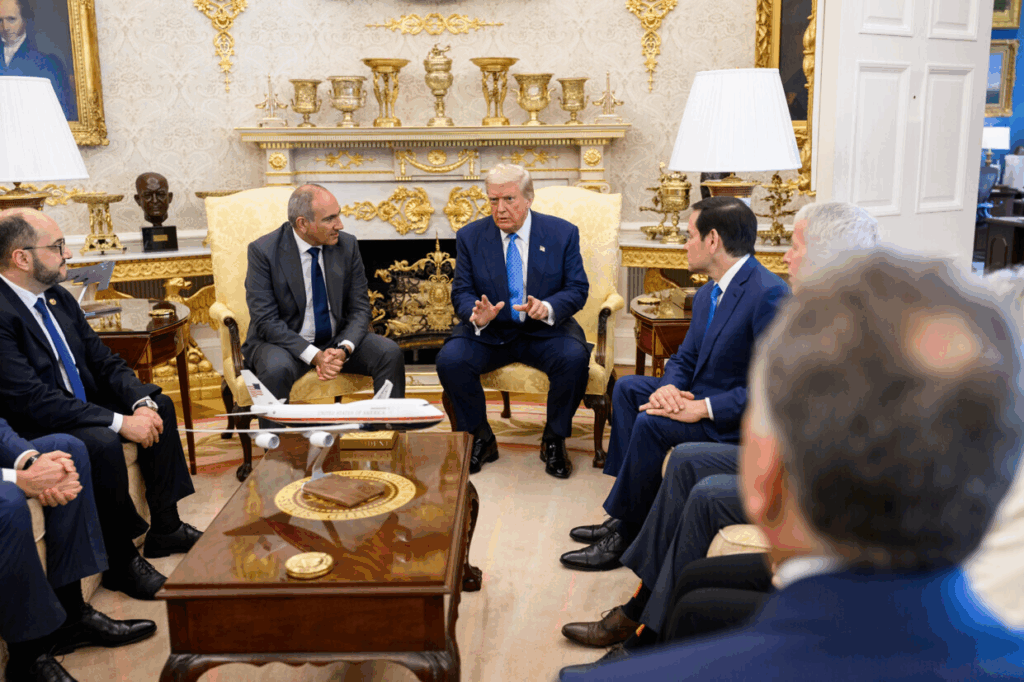
  • Trump’s vision of the People’s House features globs of gold adornment

    Photo from Donald J. Trump Truth Social.

    He has paved over the Rose Garden, erected a pair of 88-foot flagpoles, and plans a $200 million 90,000-square foot project to place a ballroom atop the East Wing — almost doubling the size of the White House. And there’s more gold by the day.

    Update: A May 27 op-ed by Emily Keegin in the New York Times (“Trump’s Oval Office Is a Gilded Rococo Nightmare. Help.”) offers more substantive commentary, history, photographs, and even a six-second GIF from a movie featuring Trump’s apartment.

    In 2017 the journalist Peter York called Mr. Trump’s aesthetic “dictator chic,” likening his New York penthouse to Muammar el-Qaddafi’s homes. Others have looked further back in history for an analogue. Many concluded not only that Mr. Trump’s style is the stuff of kings and despots but also that it’s French.
    On one level, they aren’t wrong. The decoration Mr. Trump has splattered across the Oval Office is inspired by European Baroque and Rococo of the 1600s and 1700s, when power was shown through ornate displays of grotesque abundance. Gold leaf moldings and large mirrors filled Baroque palace walls from Versailles to the Peterhof Palace. But in the early 1700s Rococo, an even gaudier style distinct for its asymmetry, swirling tendrils and gilded seashells, was born. Often criticized for being purely decorative and intellectually vacuous, it would become a perfect visual metaphor for the European royal courts of the 18th century: unserious people draped in gold baubles and ruffled pastels.

  • The Roberts Court majority is all-in with an authoritarian GOP presidency

    At the beginning of 2025, even after the Roberts Court’s majority abandoned the Constitution to grant Donald Trump virtual immunity from criminal prosecution in Trump v. United States last summer, there was more or less a consensus among commentators that SCOTUS would uphold the rule of law. Many commentaries looked to the court (some with expectation, others with hope) to reign in Donald Trump’s lawless activities. (Even this mistrustful blogger, who was not part of this consensus, hoped to be proven wrong. Alas, it was not to be.)

    After months of watching the Republican majority enable Trump’s trampling over generations of political norms, legal precedents, and an understanding of Congressional authority the Roberts Court is no longer getting the benefit of the doubt. This week in the Atlantic (“This Is the Presidency John Roberts Has Built”), legal scholar Peter M. Shane (who has written two books warning that presidential aggrandizement is eroding American democracy) points to a collection of Supreme Court decisions written by Roberts that have legitimized the extraordinary expansion of executive power wielded by Trump.

    After a review of opinions authored by Roberts, Shane writes:

    Going beyond the precise holdings in these cases, Roberts’s superfluous rhetoric about the presidency has cast the chief executive in all-but-monarchical terms. The upshot is a view of the Constitution that, in operation, comes uncomfortably close to vindicating Trump’s: “I have an Article II, where I have the right to do whatever I want as president.”

    Shane adds, “What America is witnessing is a remaking of the American presidency into something closer to a dictatorship.”

    On the Roberts legacy:

    In the two decades of his tenure thus far, his opinions on executive power have created what might be called a proto-authoritarian canon, lending constitutional legitimacy to a kind of presidency that brooks no dissent, treats Congress as a subordinate institution, and need answer to no one except possibly to the Supreme Court itself.
    It is hard to overstate how much is wrong in Roberts’s narrative of the presidency. It muddles constitutional text. It flouts constitutional history. It is willfully ignorant of the risks of authoritarianism in a polarized, populist age.

    In a previous post, I referenced Trump v. United States:

    In April 2025 we’re living with the inevitable consequences of that reckless ruling. The Supreme Court won’t check Donald Trump because the Republican majority has deliberately paved the way for Trump’s lawless assault on our democracy. Trump is the “bold and unhesitating” president this court has lionized.

    Shane is on the same page: “Trump’s use of executive power is not a distortion of the Roberts Court’s theory of the presidency; it is the Court’s theory of the presidency, come to life.”

    Allowing Trump’s defiance of trial and appellate courts

    Public policy professor Don Moynihan observes that fears that Trump would defy the courts have receded as “six Republican-appointed justices” repeatedly swoop in to overrule the lower courts:

    A couple of months ago, the major concern was what would happen when Trump defied the courts. A more complicated picture is now emerging. One that mixes quiet but unmistakable defiance of court decisions by the Trump administration with encouragement from the six Republican-appointed Justices who sit atop the judicial branch. This is an arguably worse scenario, since it provides a veneer of legalism even as it replaces the rule of law with rule by law, where Trump is allowed to determine the nature of that law.
    The emerging pattern is that the Trump administration is checked by the lower courts, slow-walks compliance, and sometimes asks SCOTUS for help, which they usually provide via poorly reasoned opinions or no opinions at all. The Supreme Court often does not feel the need to explain what are effectively constitutional amendments that rebalance the separation of powers, feeding perceptions of the court as a partisan actor.

    A partisan actor indeed. I recommend Moynihan’s analysis (“When you’re a star, the Supreme Court lets you do it”), which illustrates how the court has diminished Congressional authority, enfeebled the lower courts, ruled inconsistently (based on the political party that holds the White House), and undermined the capacity of civic institutions to oppose to a lawless president.

    Resistance to an authoritarian regime requires collective action and a judiciary willing to protect the rule of law. By empowering Trump above all branches, SCOTUS has weakened the environment for such resistance. And the Roberts court literally has argued that Trump, as President, “alone composes a branch of government.”
    It would be a mistake to treat unitary executive theory as a coherent legal framework. It is an effort by Republicans to empower Republican Presidents, now being implemented by a Chief Justice who has long held such views. Here is how Trump understands it: “I have an Article II, where I have the right to do whatever I want as president.”

    Six days ago I wrote, “It’s possible the Republican justices haven’t yet agreed on any specific rationale to put forward in McMahon; they simply agree on the result, which empowers Trump. They’ll construct their story later.”

    This morning on NPR, Nina Totenberg said that getting five or six justices to agree on a rationale could prove difficult and “they don’t have the inclination.” She remarks that

    the court’s critics, including often its own members, have repeatedly called out the practice of essentially leaving in place big, new policies without explaining its reasoning. The dirty little secret here is that if you’ve got the votes, you’ve got the votes. And if the justices actually wrote the whys and wherefores, the likelihood is that they wouldn’t agree. Writing an opinion for nine justices, or even six, or even five, can be very hard. And to put it bluntly, they think they don’t have the time and they don’t have the inclination.

    Trump’s transformation of our democracy into an authoritarian regime (consistent with the Project 2025 plan) relies on the coordination of all three branches of government. Without the acquiescence of a compliant Congress willing to do Trump’s bidding and a Supreme Court sweeping aside a Constitution built on the separation of powers it would be possible to put a stop to much of what we’ve experienced in the past six months.

    What we’ve lost

    The dirtiest little secret — though it is quickly, unmistakably coming into focus — is that the Republicans on the Roberts Court have greater fidelity to the MAGA vision than to the Constitution of the United States. This is a shamefully partisan court. Due process, the rule of law, the authority of Congress to work its will, limits on presidential power, and individual liberty as widely understood before John Roberts became chief justice — the Republican supermajority has trashed all of this in service to an authoritarian ideal.

    The cost to American democracy has been enormous. Article I established a democratically elected Congress. What are Americans to think when independent agencies, established by Congress to serve the general welfare, are diminished or wiped out with the stroke of a pen? Expertise and resources to sustain public health, scientific research, financial protection, national parks, … even timely, lifesaving weather reports — diluted or cast off altogether.

    The institutions of civil society capable of checking (in some measure) the colossal power of the state — attacked by the executive branch. Organizations that convey news and information, necessary to hold government to account — harassed until the president receives a payout. Universities, law firms, advocacy groups, even individuals — threatened and tormented by the government of the United States.

    That, and more, distressingly characterizes the new regime, which the Roberts Court has whitewashed with “the veneer of legalism.” We would not be confronting this undemocratic, unaccountable state had not the Republican justices defied the plain text of the Constitution, choosing instead to favor a MAGA perversion of America.

  • The Roberts Court’s furtive, obscure rulings that advance the MAGA agenda

    Last week, in an unsigned order (LINDA MCMAHON, SECRETARY OF EDUCATION, ET AL. v. NEW YORK, ET AL.), the Republican-appointed majority on the Supreme Court swept away a district court ruling that had blocked mass firings in the Department of Education. The district judge had determined that the Trump administration intended to dismantle the department, though it lacked the authority to do so. The SCOTUS majority ruled — without a jot of explanation — that the firings may continue.

    President Trump, consistent with Project 2025, has directed (by executive order) “the closure of the Department of Education.” Nineteen states (and other groups) filed suit to block the move, arguing that the action violated the Constitution and federal law. The Trump administration filed an emergency appeal; at least five of the Republican-appointed justices stayed the lower court’s decision (without deigning to say why).

    Justice Sotomayor penned a 19-page dissent, joined by Justices Kagan and Jackson.

    When the Executive publicly announces its intent to break the law, and then executes on that promise, it is the Judiciary’s duty to check that lawlessness, not expedite it. Two lower courts rose to the occasion, preliminarily enjoining the mass firings while the litigation remains ongoing. Rather than maintain the status quo, however, this Court now intervenes, lifting the injunction and permitting the Government to proceed with dismantling the Department. That decision is indefensible. It hands the Executive the power to repeal statutes by firing all those necessary to carry them out. The majority is either willfully blind to the implications of its ruling or naive, but either way the threat to our Constitution’s separation of powers is grave.  

    Sotomayer observed that

    the Government does not defend the lawfulness of its actions. Rather, in a now-familiar move, it presents a grab bag of jurisdictional and remedial arguments to support its bid for emergency relief. None justifies this Court’s intervention.

    Her dissent concluded:

    The President must take care that the laws are faithfully executed, not set out to dismantle them. That basic rule undergirds our Constitution’s separation of powers. Yet today, the majority rewards clear defiance of that core principle with emergency relief. Because I cannot condone such abuse of our equitable authority, I respectfully dissent.

    Quinta Jurecic observed (the week before the McMahon decision came down):

    A clear pattern has emerged in the extended back-and-forth over the legality of many Trump-administration actions. Donald Trump or a member of his Cabinet takes a certain step—say, firing an official protected from such removal, or destroying a government agency established by Congress, or seeking to ship a group of immigrants off to a country where they may be tortured or killed. Then, a lawsuit is quickly filed seeking to block the administration. A federal district judge grants the plaintiffs’ request, typically in an order that prevents Trump from moving forward while that judge weighs the underlying issue. An appeals court backs the district court’s decision. So far, so good for the plaintiffs. Then the administration takes the case to the Supreme Court—which hastily upends the lower courts’ orders and gives Trump the go-ahead to implement his plan.

    On the day of the McMahon ruling, Steve Vladeck noted:

    Since April 4, #SCOTUS has issued 15 rulings on 17 emergency applications filed by Trump (three birthright citizenship apps were consolidated).
    It has granted relief to Trump … in all 15 rulings.
    It has written majority opinions in only 3.
    Today’s order is the 7th with no explanation *at all.*

    Since April 4, #SCOTUS has issued 15 rulings on 17 emergency applications filed by Trump (three birthright citizenship apps were consolidated).It has granted relief to Trump … in all 15 rulings.It has written majority opinions in only 3.Today's order is the 7th with no explanation *at all.*

    Steve Vladeck (@stevevladeck.bsky.social) 2025-07-14T19:38:43.267Z

    In June, Professor Vladeck observed on One First:

    My friend and University of Michigan law professor Leah Litman is responsible for two of the most memorable lines about the current Court: That it’s a “YOLO” Court (you only live once), and that its defining characteristic is “no law, just vibes.” It seems to me that events of the past few months have provided a heck of a lot of fodder for those who ascribe to Leah’s view—and some pretty troubling questions for those who continue to claim that this Court is driven by analytically coherent and politically neutral legal principles in its decisionmaking. Some readers may think this has been clear for some time; others may dispute whether it’s even true today. 

    I am among the readers who “think this has been clear for some time” — though I am not an attorney. I regard the pattern as discernible to anyone who follows American politics, while keeping one eye on the Roberts Court.

    What’s wrong with this pattern? Justice Sotomayer’s dissent suggests why the Roberts Court decision to grant a stay is confounding. This was by no means an emergency. The district court had frozen the status quo; there was no compelling reason (before considering the case on the merits) to permit the firings to continue. Furthermore, the harm to the plaintiffs by staying the district court order far outweighed the harm to the federal government by keeping it in place. And, based on the constitutional separation of powers and settled law, there is no reason to suppose that the Trump administration would win the case on the merits (still being considered at the district court and ignored by the Roberts Court’s majority).

    Furthermore, outrageously, the Roberts Court majority is mum about its reasoning, offering a single paragraph describing procedural matters, to clarify its decision. It offers no hint of a rationale, much less a legal principle to spell out its reasoning. There is no way for anyone — district judge, law professor, practicing attorney, American citizen or resident, or even a dissenting justice — to understand why (that is, on what legal basis) the court ruled as it did.

    Partisan politics, not law

    Fair-minded constitutional attorneys at law schools and public policy institutions focus on law, not politics. Vladeck and Jurecic are (perhaps impatiently) waiting for the court to offer an explanation of its actions (based on the Constitution, federal legislation, and judicial precedent) in a future decision. And so far in the first half of 2025, the Roberts Court is hiding the ball.

    Let’s switch perspectives. In my view, it’s politics, not constitutional interpretation that best explains what the Roberts Court is up to. I’ve watched SCOTUS since before it became the Roberts Court. And, in my view, an understanding of American politics — and the dynamics of the contemporary Republican Party, which dominates all three branches of the federal government — not legal scholarship offers the most coherent, convincing explanation of the machinations of the current Supreme Court.

    In short, I believe that in a range of partisan cases* the court’s majority (whatever it takes itself to be doing) is moved more by fidelity to the agenda of the Republican Party, than to any constitutional or legal principles.

    *Most especially cases related to voting and elections (including campaigning, fund raising, and apportionment) and governing (especially as it relates to the authority of the three branches of government) — each of which provoke sharp partisan disagreement between Republicans and Democrats.

    By ruling in favor of Trump and McMahon, SCOTUS assures that the dirty work will be complete by the time the district court reaches a decision on the merits. The Department of Education will be gutted. The Republican majority will endorse the decision in time. The Roberts Court is advancing the MAGA agenda — with virtually every shadow docket ruling. It is hiding the ball (the reasoning that it will eventually offer to underlie its decisions) for now, which has the advantage of keeping its options open. By withholding precepts or principles now, it will have a full toolkit to select from in the future.

    It’s possible the Republican justices haven’t yet agreed on any specific rationale to put forward in McMahon; they simply agree on the result, which empowers Trump. They’ll construct their story later. For now, they are strategically keeping their powder dry.

    Am I being too cynical?

    Let me put it this way. For a number of years, even before the three Trump justices were in place, the most reliable way to predict SCOTUS decisions (in the range of partisan cases*)was to look at the policy preferences of the Republican justices, not at any purported approaches to interpreting the Constitution; not originalism, not textualism, not any consistent, coherent -ism embraced by the Federalist Society.

    In a February post(at a time when observers were discussing whether or not the Roberts Court would put a stop to the Musk-DOGE rampage through the federal government), I predicted flatly that the Republican majority would not stop Trump. I appealed to the immunity decision, Trump v. United States:

    It is preposterous to think that the Roberts Court, after giving Trump immunity from criminal prosecution — including for ordering the nation’s military to assassinate a political rival — would stand in the way of mass purges of civil servants and shuttering departments and agencies. That’s a nonstarter.

    In addition, I noted a trump card held by the administration. At a time when many commentators were predicting that Chief Justice Roberts would assert the authority of the court and insist that Trump adhere to court orders, I disagreed. Roberts’ fear of having Trump defy the court (humiliating SCOTUS) would ensure that Roberts would not block any Trump action — without providing alternative means for Trump to do whatever he wished. (In other words, any purported block would be flimsy by design.)

    In an April post, the day after the court issued a stay of a lower court ruling regarding due process for the Venezuelans deported to El Salvador (Trump v. J.G.G., decided 5-4, with the Republican men comprising the majority), I noted that in my previous prediction

    I didn’t address arrests by masked agents, deportations to Salvadorian prisons, bad faith appeals to national security, or denial of due process. But I’m consistent: the Supreme Court will not protect us from this rampage either.

    We’ll see, soon enough, whether or not I’m right. So far, nothing I’ve seen in the first six months of the second Trump administration has prompted me to change my view. I’ll conclude with an excerpt from a June post:

    The Supreme Court, with its Republican supermajority, is prepared to do its part in the MAGA campaign. Success requires the three branches of the federal government to act in concert. The court’s Republican majority has consistently (more than nine times out of ten) sided with the Trump administration. It will continue to do so, above all in the most significant cases.
    The Roberts Court is prepared to shrug off constitutional limits on the president, to override well established judicial principles, and to sabotage the rule of law itself on behalf of the wannabe strongman in the White House. It will not stand in the way of the Project 2025 crusade. It will not constrain Donald Trump.

  • Trump’s federal agents terrorize an American city

    [Carlin Stiehl/Los Angeles Times]

    The Trump administration is directing staged made-for-TV (or for-TikTok) spectacles familiar to tinpot dictators. No American alive has witnessed anything quite like this before. The effort, designed to intimidate, has been successful thus far. It is the advent of a police state.

    Yesterday in Los Angeles, California, scores of armed, masked federal agents, outfitted in military fatigues and helmets, marched across a city park, led by agents on horseback — backed by the National Guard, as armored vehicles with gun turrets blocked Wilshire Boulevard and a Black Hawk helicopter flew overhead. Minutes before the U.S. conquest of MacArthur Park, children at summer camp had been rushed from the soccer field into safety.

    “What I saw in the park today looked like a city under siege, under armed occupation,” Mayor Karen Bass said in a news conference on Monday afternoon, adding that she had traveled regularly into conflict zones as a member of Congress. “It’s the way a city looks before a coup.”

    The mayor called out the operation as un-American, asking: “What happened to the criminals, the drug dealers, the violent individuals? Who were in the park today were children. It was their summer camp, their summer day camp.”

    City councilmember Eunisses Hernandez, in whose district the park sits, had a message for Americans: “Please understand that what’s happening here in the city of Los Angeles, we are the canary in the coal mine. What you see happening in MacArthur Park is coming to you … So wake up.”

    This malicious regime will continue in Los Angeles, as Gregory Bovino, a Customs and Border Protection chief in Southern California, confirmed. “Better get used to us now, cause this is going to be normal very soon,” Mr. Bovino told a Fox News reporter. “We will go anywhere, anytime we want in Los Angeles.”

    This isn’t bravado, nor may we expect it to be confined to a single Democratic-led city. Not after the Republican majority in Congress approved Donald Trump’s Big Beautiful Bill, which provides $170 billion for Trump’s expansive border and immigration efforts, extending the coercive reach of the federal government.

    Theda Skocpol (Harvard sociologist and political scientist) observed that while the huge tax giveaways for the hugely wealthy and the unprecedented cuts to healthcare and food assistance are significant, the “massive militarization of ICE is the real heart of this law – didn’t J. D. Vance say just that a little while ago?

    He did indeed: “Everything else—the CBO score, the proper baseline, the minutiae of the Medicaid policy—is immaterial compared to the ICE money and immigration enforcement provisions.”

    Since law enforcement in the United States is primarily the province of state and local governments, Skocpol thought (last spring) that our country was protected from an authoritarian takeover. That was then.

    But now I see that the Miller-Trump ethno-authoritarians have figured out a devilishly clever workaround. Immigration is an area where a U.S. President can exercise virtually unchecked legal coercive power, especially if backed by a Supreme Court majority and corrupted Department of Justice. Now Congress has given ICE unprecedented resources – much of this windfall to be used for graft with private contractors Trump patronizes, but lots of to hire street agents willing to mask themselves and do whatever they are told against residents and fellow American citizens. The Miller-Trumpites are not interested only in rounding up undocumented immigrants. They will step up using ICE and DOJ enforcements use to harass Democrats, citizen critics, and subvert future elections if they can.

    Included in the $170 billion Republicans in Congress appropriated for border and immigration activities are $45 billion for detention centers, $30 billion for ICE to staff and run the centers, $46.5 billion to complete the border wall (though the money can be shifted to other DHS operations), $5 billion for Customs and Border Protection facilities, and a few billions more to round out the picture. These figures dwarf current spending. The 2024 ICE budget was $9.6 billion. The Bureau of Prisons budget for 2024 was $8.3 billion.

    And remember: the raids and detentions are scooping up peaceful, working class immigrants, not murderers, rapists, drug dealers, or anyone else who poses a threat to the community. Few have criminal records or histories of violence.

    Professor Skocpol identified the aim of Trump’s militarization of ICE “to harass Democrats, citizen critics, and subvert future elections if they can.” She concluded:

    “This is the key story unfolding right now. Governors and civic groups and media outlets need to get clear on this imminent threat and work together across the board to reveal and push back against the emerging ICE police state.”

  • The Roberts Court has embraced Trump’s MAGA crusade

    Stanford political scientist Adam Bonica notes (in “The Supreme Court Is at War With Its Own Judiciary“)that since May, federal district courts have ruled against Trump administration 94% of the time, while the Supreme Court has sided with the Trump administration 94% of the time.

    He describes the pattern in which district court judges gather evidence firsthand and rule that the administration has acted illegally, the administration appeals to the Supreme Court, and the high court’s majority sides with the administration in unsigned emergency orders.

    Trump’s DOJ, which has repeatedly defied judges, has been contemptuous of the authority of the courts to provide judicial oversight. Trump has defamed judges; his allies have doxed them, issued death threats, and submitted impeachment resolutions.

    Bonica concludes:

    The conservative majority knows exactly what it’s doing. These same justices would never have allowed a Democratic administration to take similar actions, like abolishing federal agencies by executive order or federalizing national guards without state approval and deploying the military against peaceful protesters. Yet when Trump bulldozes through constitutional limits, the Court waves him on.
    We are witnessing something without precedent: a Supreme Court that appears to be at war with the federal judiciary’s core constitutional function. It has chosen to bless the administration’s actions, and in doing so, systematically dismantles the authority of any court that stands in its way. The courts can’t protect the Constitution because the Supreme Court won’t let them. The Supreme Court has chosen a side, and it isn’t the rule of law.

    Trump’s Attorney General has noticed. When asked by Senator Patty Murray whether the administration ought to follow court orders, Pam Bondi responded:

    We will follow court orders, Senator. We will follow court orders. The problem arises in the district courts. All these district courts throughout the country are trying our hands. And here’s how we will follow them — when we get to the United States Supreme Court, we’re winning.

    MURRAY: Do you agree that this administration should follow court orders?BONDI: We will follow court orders. The problem arises in the district courts. All these district courts throughout the country are tying our hands. And here's how we will follow them — when we get to SCOTUS, we're winning

    Aaron Rupar (@atrupar.com) 2025-06-25T15:19:53.790Z

    This is consistent with the Project 2025 strategy. The Supreme Court, with its Republican supermajority, is prepared to do its part in the MAGA campaign. Success requires the three branches of the federal government to act in concert. The court’s Republican majority has consistently (more than nine times out of ten) sided with the Trump administration. It will continue to do so, above all in the most significant cases.

    The Roberts Court is prepared to shrug off constitutional limits on the president, to override well established judicial principles, and to sabotage the rule of law itself on behalf of the wannabe strongman in the White House. It will not stand in the way of the Project 2025 crusade. It will not constrain Donald Trump.

  • “The Trump Doctrine is ‘We’re America, bitch.’ That’s the Trump Doctrine.”

    In June 2018, Jeffrey Goldberg described an exchange (which he relayed again in the Atlantic this month) with a senior White House official regarding Trump’s approach to world affairs. Goldberg suggested that it might be too soon to identify a Trump Doctrine; the official disagreed and offered the words in the headline above:

    “The Trump Doctrine is ‘We’re America, bitch.’ That’s the Trump Doctrine.”

    Goldberg suggested:

    “We’re America, Bitch” is not only a characterologically accurate collective self-appraisal—the gangster fronting, the casual misogyny, the insupportable confidence—but it is also perfectly Rorschachian. To Trump’s followers, “We’re America, Bitch” could be understood as a middle finger directed at a cold and unfair world, one that no longer respects American power and privilege. To much of the world, however, and certainly to most practitioners of foreign and national-security policy, “We’re America, Bitch” would be understood as self-isolating, and self-sabotaging.

    I agree with Goldberg’s assessment that

    what is mainly interesting about “We’re America, Bitch” is its delusional quality. Donald Trump is pursuing policies that undermine the Western alliance, empower Russia and China, and demoralize freedom-seeking people around the world. The United States could be made weaker—perhaps permanently—by the implementation of the Trump Doctrine.

    As abroad, so too in America

    But, when I recently read Goldberg’s June 2025 piece, what struck me about the Trump Doctrine is that it captures Trump’s approach to domestic politics as well as foreign policy.

    At the center of Trump’s approach to American politics is denigration of his political opponents. Dividing the country into us (his MAGA allies, Trump loyalists) and them (folks who oppose Trump and the MAGA agenda), the president regards only the former as genuine Americans, worthy of respect and deserving a voice in political affairs.

    His venom is mostly (though not exclusively) aimed at Democrats, since Democrats comprise the opposition party. “They’re Marxists and communists and fascists, and they’re sick,” as well as ‘radical left lunatics,’ ‘evil,’ and ‘dangerous.’ Not to mention, ‘scum,’ ‘animals,’ ‘evil,’ and ‘enemies of the people.’ It doesn’t matter which demeaning insult you choose: it is no wonder that anyone so characterized would be regarded as unworthy of legitimate political standing in the country.

    We hear these insults daily. On Fox News Channel, from Trump and Republicans, posted on Truth Social and Twitter. This is hardly news. But make no mistake, Trump is the only president (perhaps ever, but certainly) in our lifetimes who has never sought to represent America in full. He has consistently catered only to (one faction or another of) his base — the real Americans. Not the blue city or blue state Americans.

    Trump makes us weaker as a nation when he writes off half the country. His demolition of the capacity of the federal government, his attacks on civil society (media, law firms, higher education, science), his anti-immigrant crusade — all of this strips away what makes America great. To achieve his ends, Trump has waged war on the liberty the Constitution grants us and on the rule of law itself. The Republican Party, remade in his image, and the folks inside the tent are on board with what they regard as a winning project.

    Hence, it was hardly surprising when his Vice President visited Los Angeles and displayed open, gleeful contempt of the Democratic officials elected by Californians. A week after Secretary of Homeland Security Kristi Noem trolled of liberating the city and state (seconds before a man who represents California in the United States Senate was pushed to the floor and handcuffed), JD Vance insulted Alex Padilla by misnaming him.

    “I was hoping Jose Padilla would be here to ask a question, but unfortunately I guess he decided not to show up because there wasn’t a theater, and that’s all it is,” Vance said.

    Vance served in the Senate with Padilla; he presides over the Senate now. He knows his name. He knows he is Latino. Why the juvenile putdown invoking a popular Mexican name? Just a joke? Gustavo Arellano, who offers a lesson in the historical use of ‘José’ as racist ridicule in today’s Los Angeles Times, remarks:

    That Vance reduced Padilla’s attempted questioning of Noem to a charade shows what a clown he is. Spitting out “José” like a villain in a low-budget western reveals his rank racism. And if you think I’m exaggerating, consider how Vance’s press secretary, Taylor Van Kirk, responded when Politico asked her to elaborate on his José insult: She said her boss “must have mixed up two people who have broken the law.”

    Humor? Trolling? Or more purposefully an authoritarian move to denigrate the senator’s views as illegitimate? He doesn’t count. Nor do his constituents. We’re standing up for real Americans. That’s why the National Guard and the Marines are in the streets of L.A.

    “We’re America, bitch” in contemporary American politics is the brush off for folks outside the MAGA tent. It’s (in Goldberg’s words) “the middle finger directed” at everyone of us who opposes Trump politically.

    In the Trump era, MAGA dominates all three branches of government. Trump dictates. Congress defers. And the Supreme Court paves the way.

    Welcome to today’s America.

  • Donald Trump yearns to be a strongman. He is trampling on American democracy.

    [Stephen Miller, White House Deputy Chief of Staff.]

    Donald Trump and immigrant labor

    In February 2015, Senator Marco Rubio issued a press release, “Fact Check: Donald Trump Used Illegal Immigrants to Build Trump Tower,” relating a story about ‘illegal immigrants’ working 12-hour shifts at $5/hour without overtime to demolish the building that made way for Trump Tower.

    Similar stories appeared in the press during Trump’s first go-round in the White House: “Trump Winery requests permission to import more foreign migrant workers” (2017), “3 Trump properties posted 144 openings for seasonal jobs. Only one went to a US worker.” (2018), and “Trump Says Mar-A-Lago Can’t Find US Workers To Hire. New Documents Show Dozens Applied.” (2019), for instance. In July 2019, the New York Times asked Trump about such reports:

    After months of silence, President Trump responded on Friday to reports that the Trump Organization has employed dozens of undocumented immigrants by saying that he doesn’t know whether the organization does or not.
    “I don’t know because I don’t run it,” Mr. Trump said when asked if he was confident that undocumented immigrants were no longer working at his golf courses. “But I would say this: Probably every club in the United States has that because it seems to be, from what I understand, a way that people did business.”

    Such reports continued in 2024 (“Donald Trump’s Truth Social business applied for the foreign worker visa that the former president called ‘very bad’ and tried to restrict” and “Trump Media Outsourced Jobs to Mexico Even as Trump Pushes “America First”)and 2025 (“As Trump pursues mass deportation, his businesses again seek foreign workers” and “Trump Org Keeps Bringing In Foreign Workers To Staff Its Clubs And Winery”).

    I raise this issue not to harp on hypocrisy, but to illustrate that, no matter how factually-challenged our president is, he understands that immigrants (with or without papers) play a critical role in the nation’s economy. In some instances, the “way that people did business” has been simply a way to cut costs, because undocumented immigrants are often willing to work for less and have fewer options when they are cheated. But that’s not the whole story.

    A number of industries, from hospitality to farming to the building trades would experience dire labor shortages without immigrant labor. (More than ten thousand homes burned in the devastating fires in Los Angeles County just months ago — in a state that has failed to provide affordable housing even without this loss.) Federal visa policies and legal avenues for recruiting foreign workers are inadequate.

    While Trump has acknowledged (as recently as yesterday) — because he has spoken with rich friends with financial interests in federal policy — the structural challenges in the agricultural and hospitality sectors, he doesn’t seem intent on reforming immigration laws to make them workable. Instead, on the one hand, Trump will carve out exceptions for cronies, allies, and loyalists, while, on the other hand, he’ll go after immigrants working low paying jobs (day laborers, attendants at car washes, sidewalk vendors, garment workers, line cooks, and so on). These are in most instances jobs that few citizens are clamoring for. Yet they’re essential.

    Militarized federal policy in Los Angeles

    A 37-year-old U.S. citizen who was tackled to the ground and arrested after filming federal agents at Home Depot on Thursday said he was held for more than an hour near Dodger Stadium, where agents boasted about how many immigrants they arrested.
    “How many bodies did you guys grab today?” he said one agent asked.
    “Oh, we grabbed 31,“ the other replied.
    “That was a good day today,” the first agent responded.
    The two high-fived, as he sat on the asphalt under the sun, Job Garcia said.

    That’s a report from the Los Angeles Times on Trump’s militarized federal policy on immigration.

    Why is this happening? Why the raids by the feds? To instill fear: fear to drive to work or stop at a grocery store or attend a child’s graduation.

    To disrupt civic life. To separate families. To empty the streets and shopping malls and public gathering places. To strangle businesses. To outrage citizens offended by the police state tactics. To provoke violence in order to justify and amp up the military occupation. To intimidate critics and would-be critics. To punish blue cities, blue regions, blue states — and their elected representatives. To rehearse ambushes, detentions, arrests, and deportations that will roll out in other blue cities and states.

    But most of all: This is a campaign to expand the power of the presidency beyond anything previously experienced in the history of our country. To shrug off legal constraints, shunt aside Congress, and cripple institutions of civil society (media, law firms, universities, and even Democratic governors and mayors). This campaign makes a mockery of the Constitution, of checks and balances, federalism, state sovereignty, and the rule of law.

    Trump is conducting a frontal assault on our democratic institutions, on what — I dare say — makes America great.

    Project 2025 made a plan for this assault. The Trump 2 administration is carrying it out. They have theories to justify what they’re doing.

    The whole will of democracy is imbued into the elected president. — Stephen Miller

    A plain reading of the Constitution and of the Federalist Papers suggests otherwise, but Trump is on board with the idea:

    It’s good to have a strongman at the head of a country. — Donald Trump

    These are the guys in charge. Small-d democratic governance in the United States has never been so precarious.

  • Trump’s agents are hardly focused on “the worst of the worst.” The truth is uglier.

    Brad Lander isn’t resisting at all.

    Why was the NYC comptroller arrested? The feds announced that he would be charged with “assaulting law enforcement,” but no one witnessed that — and there was a video to substantiate witness accounts. The charges were dropped.

    Why aren’t the federal agents in uniform — with badges identifying themselves and their agency? Why — in this case and many others, including agents working outdoors — are agents so often masked up?

    Phillip Bump explores the latter question today. In May, the acting director of ICE asserted, “ICE officers have seen a staggering 413 percent increase in assaults against them.” Bump reports that not only is there no evidence for this, there is ample evidence against this claim. ICE reports show assaults on agents have declined from 2024 to 2025. DOJ and ICE have reported only a dozen such assaults in 2025. For context: in April ICE announced that it had conducted 66,463 arrests since Trump’s inauguration.

    Furthermore, ICE has failed to provide “any examples of immigration officers being identified, targeted and assaulted outside of the context of an arrest.” The handful of agents purportedly assaulted or threatened with assault — with an elbow to the face (as reported by ICE), for instance — were all injured or threatened as they carried out their duties. None were doxed or targeted away from work. So why the masks?

    On April 29, DHS released a report claiming, “Under President Trump, U.S. Immigration Customs and Enforcement (ICE) is targeting the worst of the worst, 75% of their arrests are criminal illegal aliens with convictions or pending charges.” Don’t believe it. A CNN report reveals a different story:

    As the Trump administration has ramped up raids in Los Angeles and around the country, top officials have highlighted the capture of immigrants convicted of crimes like murder, assault and rape — describing them as “barbaric” criminals who “reigned terror” on American communities.
    But internal government documents obtained by CNN show that only a fraction of migrants booked into Immigration and Customs Enforcement custody since October have been convicted of serious violent or sexual crimes.
    Public ICE data released by the administration shows that most immigrants currently in the agency’s custody do not have a prior criminal conviction. But the internal data reviewed by CNN goes deeper, making clear that even among those convicted of crimes, a substantial percentage faced only relatively minor charges.

    Earlier this week, Donald Trump boasted on Truth Social of “the largest Mass Deportation Operation of Illegal Aliens in History.” But hitting that goal requires arresting thousands of immigrants who are far from “the worst of the worst.” Last week Trump posted that his aggressive policy on immigration was “taking very good, long time workers away from” farmers and people (like Trump himself) in the hotel and leisure industry.

    Trump’s federal police forces must arrest thousands of “very good, long time workers” to hit Stephen Miller’s goal of 3,000 arrests a week. In spite of Trump’s tweet on farms and hotels, the arrests have continued, at least in blue cities and states. And of course in Home Deport parking lots, carwashes, restaurants, swap meets — wherever immigrants gather to work or shop or go about their business.

    American citizens, acting as though their rights will be protected, have been caught up in the confrontations staged by ICE:

    20-year-old U.S. citizen Adrian Andrew Martinez was swarmed by ICE in Pico Rivera while defending someone. He never hit back—just struggled—before being slammed into a CBP van. No records. No lawyer. His mom can’t find him. This is abuse of power. Keep recording. Don’t stop.

    David Earl Williams III (@dewforpolitics.bsky.social) 2025-06-18T15:26:12.949Z

    Eventually, the feds announced that the young man would be charged with punching an agent, but — unless they release evidence that we haven’t yet seen — the video record would seem to contradict this charge. Instead, we see ICE agents acting aggressively, shoving people around, including folks making videos with their smartphones. We see no attacks by anyone in the crowd or any agents getting punched in the face.

    The attack on communities in blue cities and states

    Contrary to Trump’s campaign promises and the lies his administration continues to spread — his immigration crackdown is aimed overwhelmingly at people who are peaceful, productive members of their communities. It’s not making any of us safer or more secure.

    Recall again, that federal forces are targeting blue cities and states, beginning with Los Angeles, California. This policy aims to disrupt life for everyone in this city. To punish Democratic officials duly elected and their constituents — citizens and immigrants alike. And it is succeeding, as the Los Angeles Times reports:

    With federal immigration sweeps showing no signs of slowing across Southern California, there is growing concern from top officials, spiritual leaders and business owners that a climate of fear was sending more people underground and changing the rhythm of city life.
    Once-bustling immigrant hubs, including MacArthur Park, the Garment District, downtown’s produce market and areas of the Eastside have seen a noticeable reduction in foot traffic over the last week, with some businesses forced to close as a result.
    It comes as social media is rife with videos of people spotting immigration agents at shopping centers, markets and neighborhood streets, and capturing federal agents making arrests at swap meets, car washes and other businesses.

    Trump’s aim is to punish his political enemies. He won’t make L.A. or California any safer. He certainly won’t make the city or America great again. Instead, he is wreaking havoc. He is terrorizing the immigrants who make things work in this community. He is with a single vindictive policy damaging the region’s economy.

    This is terror inflicted on Americans, though Americans whom he and MAGA Republicans from Fox News to Twitter to the United States Congress have slandered as un-American (via a whole catalogue of demeaning and insulting language).

    That’s why … the masked agents who look and act like street thugs — something we’ve witnessed in other less democratic, more authoritarian countries. The headlines right now, as our president pledges “within the next two weeks” to decide whether to drop a bunker-buster on Iran, feature MAGA factions wishing to avoid war. These America Firsters, from Marjorie Taylor Green (“We are sick and tired of foreign wars. All of them”) to Tucker Carlson to Steve Bannon to JD Vance, are fine with creating fear and inflicting pain on vulnerable people in communities dominated by MAGA critics — and on collective punishment on whole regions. The immigration raids aim to do harm to Americans who politically oppose Donald Trump.

    This administration and today’s Republican Party are just fine with the divisive, destructive assault on blue cities and states. Unleashing force and generating fear appeal to the wannabe strongman in the White House. ICE, DHS, DOJ, the National Guard, the Marines, and more: the President can unleash the power of the federal government to inflict great harm on his political enemies. Trump is directing a war against half of America.