Month: May 2026

  • Suddenly the Republican majority on the Roberts Court is in a mad rush

    The Roberts Court has, in a rush, offered “a series of major upheavals in the past month,” beginning with Louisiana v. Callais, which gutted the Voting Rights Act while pretending not to, followed by a pair of quick shadow docket rulings (which cast aside the court’s Purcell principle that cautioned against changing voting rules close to scheduled elections) setting off a frenzied scramble in Republican states to create freshly gerrymandered districts, eliminating Black representation, before the states’ 2026 primaries.

    Rick Hasen began a commentary (quoted above) on these judicial machinations with these words: “Over his two decades on the Supreme Court, United States Chief Justice John Roberts had consistently played the long game when it comes to the court’s weakening of voting rights. That was until the past few weeks.”

    Hasen cites an op-ed he wrote in 2013 (after the Shelby County decision) to illustrate the chief justice’s pattern of playing the long game:

    In an opinion brimming with a self-confidence that he hides behind a cloak of judicial minimalism, Chief Justice John G. Roberts Jr., writing for a conservative Supreme Court majority in Shelby County v. Holder, cripples Section 5 of the Voting Rights Act.
    The court pretends it is not striking down the act but merely sending the law back to Congress for tweaking; it imagines that Congress forced its hand; and it fantasizes that voting discrimination in the South is a thing of the past. None of this is true.
    In the Shelby decision, we see a somewhat more open version of a pattern that is characteristic of the Roberts court, in which the conservative justices tee up major constitutional issues for dramatic reversal. First the court wrecked campaign finance law in Citizens United. On Tuesday it took away a crown jewel of the civil rights movement. And as we saw in Monday’s Fisher case, affirmative action is next in line, even if the court wants to wait another year or two to pull the trigger.

    You can still count on the court’s pattern of pretending, imagining, and fantasizing without regard for what is true. That hasn’t changed. But, until recently, you could count on the chief justice’s drawing things out, signaling before pulling the trigger, playing the long game. “That was until the past few weeks.” Now the court is in a big hurry. Hasen continues:

    The court did not have to proceed in such a hurried fashion. It could have waited to intervene in the Alabama case until the fall. It could have waited its typical 32 days for Callais to go into effect. It could have even held the case until the end of its term in late June or early July, when the primary season was over. It could have signaled, as the Supreme Court did in 1964’s Reynolds v. Sims, establishing the “one person, one vote” rule for state legislative districts, that because of “equitable considerations,” it would not be applying the new rule to the impending elections. It could have said that Purcell considerations militated against immediate change. Instead, the court’s conservatives have made an unusually mad dash toward radical change.

    Why the rush?

    Hasen offers three possible reasons. Although he offers them as either-ors, it’s easy enough to see each of them as factors motivating Roberts and his Republican colleagues.

    First, pure partisanship. There is little doubt that the redistricting decisions (Callais and the shadow docket follow ups) will advantage Republicans and disadvantage Democrats in the 2026 and 2028 Congressional elections. (Yeah, but wouldn’t you expect Roberts to look a bit further ahead than a couple of election cycles?)

    Second, motivated reasoning. In other words, the decisions advantage Republicans, but the Republican justices are not conscious of their gross partisanship. (Implausible? Maybe, maybe not. My first response to Alito’s declaration of historical progress in his Callais opinion — “And if, as a result of this progress, it is hard to find pertinent evidence relating to intentional present-day voting discrimination, that is cause for celebration.” — was: He’s trolling us! But other observers appear to accept this as what the man actually believes. It’s hard to doubt that the Republican justices are living in a bubble that could spark motivated reasoning.)

    The third possibility: Roberts has decided it’s time to cut to the chase. Here’s how Hasen puts it:

    Third, perhaps John Roberts sees the court as running out of time, and he wants to get many rulings in the books that change American politics in his preferred direction and forestall the move toward a multiracial democracy. He’s a 71-year-old chief justice now, not a 26-year-old staffer. The Supreme Court’s rulings in cases ranging from abortion to presidential immunity to the power of the government to fight climate change are growing increasingly unpopular. In the most important cases, the court is now splitting along not just ideological lines but party lines: All the conservative justices on the court have been appointed by Republican presidents, and all the liberals by Democrats.
    Roberts well knows that Democrats and progressives are mobilizing against the court. The chief justice has complained about the public viewing the justices as political actors, but that is exactly what they are. People, including me, who had resisted Supreme Court reform, increasingly see it as the only way to save American democracy.

    I wholeheartedly agree that Roberts “wants to get many rulings in the books that change American politics in his preferred direction and forestall the move toward a multiracial democracy.” It is possible that the other Republican justices forced the chief justice’s hand; there may have been a majority for this decision even without Roberts. Or perhaps Roberts would have done less slow-walking in previous years if the majority then had been less restrained.

    Republican justices have constituted the Supreme Court’s majority for more than 50 years, but the confirmation of Donald Trump’s three nominees — after the Federalist Society’s vow of “no more Souters” — tilted the balance of the court dramatically.

    Following Rucho v. Common Cause (2020), when two of Trump’s picks had been seated and Republicans constituted the 5-4 majority, the Callais decision this year, with an additional Republican joining the majority for a 6-3 victory, set off a furious scramble in Republican controlled statehouses to implement extreme gerrymanders of Congressional district maps. (State legislative maps and redistricting of localities will come next.)

    The Roberts Court deliberately brought about this race to bottom, undermining fair representation and equality among voters. This was a choice. A partisan, political choice. Rucho and Callais taken together appear laser focused on impairing the Democrats’ prospects of winning elections at the federal, state, and local levels.

    Add a third ruling, after the 6-3 Republican supermajority was in place: Trump v. United States (2024) was completely untethered from the Constitution or anything else that could possibly justify such a reckless decision. We have witnessed the results with Trump 2.

    Each of these three decisions — and there have been a number of others — are fundamentally at odds with democratic principles. They are antithetical to American democracy. But never before fall 2020, with the confirmation of the third Trump justice, has the Republican majority on the Roberts Court been more powerful or more unaccountable. Playing the long game, holding back now, makes little sense. Never in the Trump era has an authoritarian victory been so close at hand.

    While Democrats (some of them) have begun to realize that undoing these decisions and disempowering these justices are critical to winning elections, to regaining power, and to implementing public policies that the Roberts Court will not strike down, the Republican justices have done their best to diminish Democratic prospects and marginalize Democratic voters.

    The Roberts Court, seeing an opportunity to secure a convincing and durable victory over opponents of a MAGA America, has no interest in restraint.

  • John Oliver explains the Supreme Court’s shadow docket. No kidding.

    If you have 22 minutes and you’re curious, John Oliver on “Last Week Tonight” explains the shadow docket. Steve Vladeck, the man who wrote the book (The Shadow Docket: How the Supreme Court Uses Stealth Rulings to Amass Power and Undermine the Republic) recommends Oliver’s explanation.

    Other than discovering that I’m apparently John Oliver’s son, @lastweektonight.com’s deep dive into the shadow docket is really quite good:www.youtube.com/watch?v=qKeq…

    Steve Vladeck (@stevevladeck.bsky.social) 2026-05-11T11:50:23.172Z

    Plus: gerrymandering race to the bottom and the chief justice’s complaints that the court is misunderstood

    On a related note, Professor Vladeck, a savvy court watcher, weighed in today (at One First) on the redistricting chaos the Supreme Court chose to unleash and the unconvincing insistence of the chief justice that the court is not political.

    I really didn’t want to write about redistricting again, but events in the latter part of last week seemed to demand it. It’s not just the brazen racism we’ve seen in some of the state legislatures that are rushing to eliminate majority-minority districts (e.g., “y’all need to shut up, boy”), or the not-exactly-obvious reading of Virginia law that the Virginia Supreme Court adopted to nix Virginia voters’ attempt to belatedly redraw the Commonwealth’s congressional districts, but also Alabama’s … aggressive … requests for emergency relief to the U.S. Supreme Court to let it get out from under earlier district court rulings—including ones the Supreme Court affirmed on the merits—so it can re-draw its maps in time for this cycle.
    All of this came the same week that Chief Justice Roberts, in remarks at the Third Circuit Judicial Conference, complained about the public perception that the Court is “political.” In his words, “I think [people] view us as purely political actors, which I don’t think is an accurate understanding of what we do.” Shortly after that, he added that the Court is “simply not part of the political process.”
    Roberts may tell himself that the Court is not part of the political process, but the (growing) evidence is overwhelmingly to the contrary. Indeed, the Court inserted itself into the midterm cycle—and set off this race to the bottom—knowingly (if not deliberately), both in what it ruled in Callais and in its willingness to issue the judgment immediately. That latter development was an unmissable signal that it was not averse to having this exact kind of chaos unfold on the ground—a point Justice Jackson made explicitly in her dissent from last Monday’s order. In her words, “as always, the Court has a choice.” By issuing the Callais judgment immediately, the majority “unshackles itself from [doctrinal] constraints . . . and dives into the fray.”
    This, to me, is the key point: whatever one thinks of the ruling in Callais, the Court chose this chaos. And now that it is on the receiving end of applications from Alabama (and with an application from Virginia apparently on the way), to suggest the Court is not “part of the political process” is to deny the entirely obvious (and entirely predictable) consequences of the Court’s own behavior—not just in Callais, but before April 29 and since. Worse than that, all of these developments rather fatally undermine what I’d always understood to be the animating purpose of the so-called Purcell principle”—which makes sense only as a strong norm against federal judicial intervention in the middle of election cycles. The Court’s own interventions are now wreaking havoc—and a majority of the justices either don’t think it’s their fault, or don’t care that it is. Either way, they don’t seem to mind the inconsistency—in a context in which it’s having the remarkably coincidental effect of benefiting Republicans.

    Vladeck elaborates on these points and explains the Tim Robinson meme — image above — that inspired the title of his post at One First.

  • John Roberts, speaking for the robed ones, believes the court is misunderstood

    “I think, at a very basic level, people think we’re making policy decisions, we’re saying we think this is how things should be, as opposed to what the law provides. I think they view us as purely political actors, which I don’t think is an accurate understanding of what we do.”Chief Justice John Roberts, May 6, 2026

    Come hell or high water in the Trump era the Roberts Court has almost always found a way to enable Donald Trump and advance the interests of the contemporary Republican Party. The 6-3 Republican supermajority has given us Trump v. United States (July 1, 2024) and Louisiana v. Callais (April 29, 2026), which, among a host of other decisions, have strengthened the evidence that the Republican justices have less fidelity to the Constitution than to a partisan agenda. The latter decision, the latest in a pattern, illustrates the Roberts Court’s hostility to the Reconstruction Amendments.

    Of these amendments, Eric Foner has written:

     The 13th Amendment irrevocably abolished slavery. The 14th constitutionalized the principles of birthright citizenship and equality before the law. The 15th sought to guarantee the right to vote for black men throughout the reunited nation. All three empowered Congress to enforce their provisions, radically shifting the balance of power from the states to the nation.
    The amendments had flaws. The 13th allowed involuntary servitude to continue for people convicted of crime, inadvertently opening the door to the creation of a giant system of convict labor. The 14th mandated that a state would lose part of its representation in the House of Representatives if it barred groups of men from voting but imposed no penalty if it disenfranchised women. The 15th allowed states to limit citizens’ right to vote for reasons other than race.
    Nonetheless, the amendments should be seen not simply as changes to an existing structure but as a second American founding, which created a fundamentally new Constitution.

    The majority on the Roberts Court is intent on clawing back what Congress intended in the post-Civil War era and again (as recently as 1982) what Congress intended following passage of the 1964 Civil Rights Act and the Voting Rights Act of 1965. With the decision on April 29, the six Republican justices have succeeded in demolishing the VRA.

    Louisiana v. Callais will have dramatic consequences going forward — eliminating Black representation in Congressional districts, state legislatures, and local governing bodies. In fact, dramatic changes are already taking place, as a number of Republican states rush to redistrict and disable Black voting strength before the November 2026 elections.

    [“Deadline: White House,” July 1, 2024. Marc Elias begins speaking at the 8:27 mark]

    On the day theTrump v. United States decision was handed down, Nicolle Wallace asked voting rights attorney and activist Marc Elias for his response, which is worth quoting in full:

    I think that we run the risk even on a day like today of overly lawyering, legalizing what the Supreme Court has done.
    Let’s be clear. As you know, you’ve heard they knew exactly what they were doing not just for the past but for the future. Donald Trump is campaigning on a platform of being a dictator for a day and of seeking vengeance against his enemies. And, you know, to do that he needs the support of a lot of people who are going to go along with him.
    Well, what have those people who have gone along with him learned in the past couple weeks? Number one, that the U.S. Supreme Court was going to narrowly construe a statute that went after January 6 insurrectionists. Number two, the Supreme Court was going to let Donald Trump remain on the ballot. Number three, that the Supreme Court was going to give him basically absolute immunity, not just for what he did last time, but what he may do in the future. And that his pardon power is absolute.
    So let’s be clear. It’s not just that the Supreme Court knew what it was doing with respect to the to the criminal cases that have been indicted. The Supreme Court knows what it’s doing with respect to empowering his attitudes and his impulses and those of his followers as we are four months from the next election, four and a half months from the next set of lawsuits, five months from the next insurrection at the Capitol, and then potentially four years of him seeking vengeance and misusing power to go after his political opponents and to prosecute his case against the American people.
    It is a shameful day for democracy. The court has disgraced itself. And I’ll tell ya, everyone one of us needs to be steeled for a battle to stand up for the rule of law going forward.

    Wallace followed up: “Can I just ask you one last question, Marc Elias. In your view, why?” His response:

    Because they agree with him.
    You know, one of the things that has always struck me as odd in this town is that people look at a bunch of justices and they say: Well, you know they all went to Harvard and Yale Law School. And they all went to the best colleges. And they send their kids to the same schools that our kids go to. And you know they enjoy a glass of wine with a crudité at a reception at the Supreme Court. And they wear robes and they speak in very flowery language. They’re just like us.
    No. They actually believe that Donald Trump is the future of America. They believe that the flag should be flown upside down, indicating distress, when Joe Biden wins. They believe that Donald Trump as a strongman should have immunity.
    And it’s time that, you know, people that are in the center, the center-left, the center-right, stop looking at justices and thinking, Well, they must share our value system.
    They don’t share our value system. They share his value system.

    We have no reason to doubt this assessment and every reason to believe that when we watch the Roberts Court, we understand exactly what it is doing. This court is making policy decisions based on partisan preferences. It is enabling an authoritarian Republican president. At the same time, it is disabling Democratic public policies (such as the Voting Rights Act).

    The Roberts Court is relying not on the Constitution, not on originalism, not on conservative judicial principles (such as judicial restraint, adherence to precedent, or respect for the coequal branch of government established by Article I). These Republican justices are dedicated to boosting the MAGA political agenda, because they prefer an earlier America than the one we have lived in since the second founding. They are imposing their political preferences on the nation.

  • Roberts Court overrules Congress to evicerate voting rights guaranteed by the Reconstruction amendments

    With last week’s decision in Louisiana v. Callais the six Republican justices on the United States Supreme Court wrung the life out of the Voting Rights Act of 1965, killing off the protections it had offered minority voters.

    Election maven Rick Hasen offered this assessment:

    Wednesday’s 6–3 party-line decision in Louisiana v. Callais will go down in history as one of the most pernicious and damaging Supreme Court decisions of the last century. All six Republican-appointed justices on the court signed onto Justice Samuel Alito’s opinion gutting what remained of the Voting Rights Act protections for minority voters, while pretending they were merely making technical tweaks to the act.
    This decision will bleach the halls of Congress, state legislatures, and local bodies like city councils, by ending the protections of Section 2 of the act, which had provided a pathway to assure that voters of color would have some rudimentary fair representation. It’s the culmination of the life’s work of Chief Justice John Roberts and Samuel Alito, who have shown persistent resistance to the idea of the United States as a multiracial democracy, and a brazen willingness to reject Congress’ judgment that fair representation for minority voters sometimes requires race-conscious legislation. It gives the green light to further partisan gerrymandering. It protects Alito’s core constituency: aggrieved white Republican voters. It’s a disaster for American democracy.

    The Voting Rights Act of 1965 has been called “the single most effective piece of civil rights legislation ever passed by Congress.” In fact John Roberts himself has made reference to this judgment. Quoting (in an internal memo during his service in the Reagan administration) a sentence of Section 2 of VRA, Roberts wrote: “This provision, which is an important part of what has been uniformly described as the most successful civil rights law ever enacted, is applicable nationwide.”

    Voter suppression

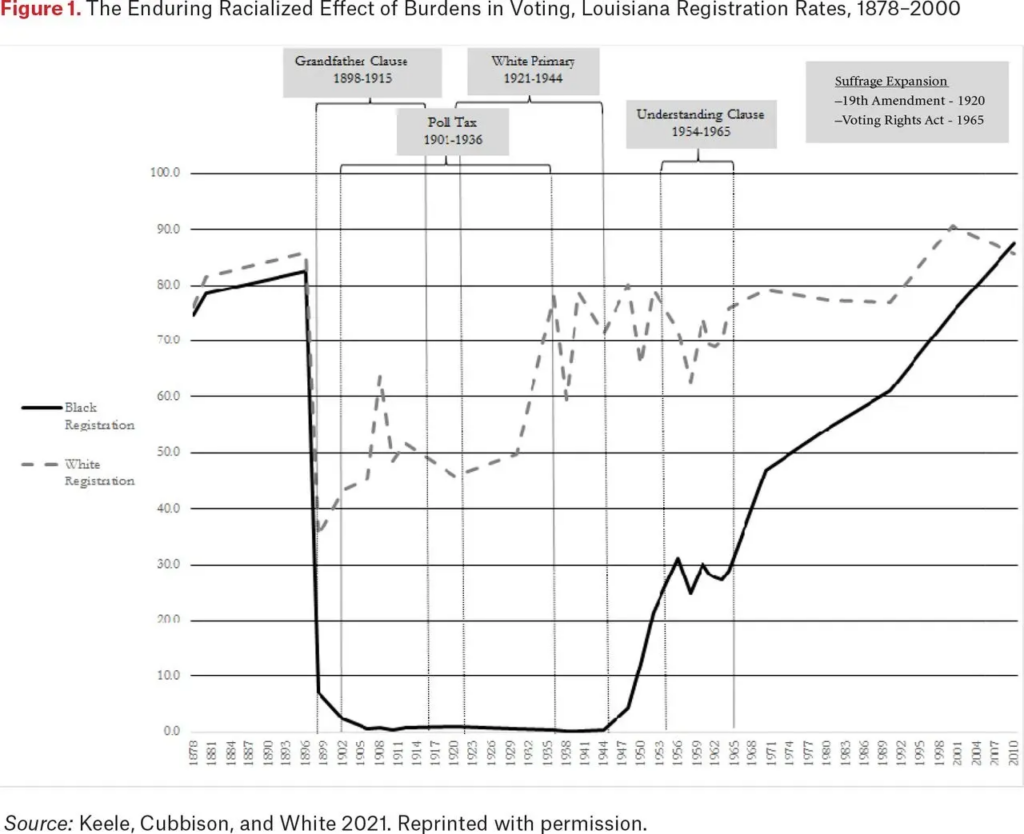
    Don Moynihan offers a graph that presents registration rates of Black and White voters in Louisiana from 1878 to 2010. As you can see, the most dramatic changes in Black voter registration occurred with the advent of Jim Crow and then with passage of the VRA.

    Regarding the graph, Moynihan observes:

    In a single image, it tells the story of political power and discrimination. Black voters had power, briefly, then it was taken from them. A series of policies that were more or less explicit in their discriminatory purpose worked as intended, disenfranchising Black voters, and some poor White voters along the way.
    This ended with the Voting Right Act of 1965, which removed the ability of governments to put in place facially neutral but clearly discriminatory practices, and in doing so ratcheted up Black registration in Louisiana until it matched White voters. This effect was immediate and enduring across the South.

    While violence and intimidation were widespread during the Jim Crow era ( just months before passage of the VRA the country witnessed the bloody clash at the Edmund Pettus Bridge), election law was often enough to keep Black folks from registering. And note that the practices that disenfranchised Black voters during the Jim Crow era were represented as color-blind; in Moynihan’s words, they were “facially neutral but clearly discriminatory practices.” Poll taxes, literacy tests, exams assessing good character, property requirements, and so on were effective instruments in the hands of state officials who wished to preserve White rule.

    The decades-long crusade of John Roberts

    When a young John Roberts wrote the memo quoted above, he was the Reagan administration point person to defeat an amendment to the VRA. A 1980 Supreme Court opinion (City of Mobile v. Bolden), a 6-3 ruling with the Republican justices constituting the majority, had overruled an appellate court decision that the VRA rendered a gerrymandered district map (icing out Black representation) illegal. The SCOTUS majority, in overturning this decision, held that “action by a State that is racially neutral on its face violates the Fifteenth Amendment only if motivated by a discriminatory purpose.”

    Congress, granted the power to enforce the Fifteenth Amendment by Section 2 of that amendment, did not agree. Roberts and the Reagan White House lost that battle. The 1982 legislation — passed with bipartisan support and signed into law by President Reagan — clarified that states were prohibited from introducing voting procedures with discriminatory effect.

    But Roberts stayed the course. It was his “life’s work,” as Hasen noted. The Roberts Court has chipped away at the VRA in decision after decision. Finally, more than four decades after that initial defeat, Roberts has finally succeeded in demolishing the VRA. Sam Alito wrote the 6-3 decision in Louisiana v. Callais, powered by the Republican supermajority on the court.

    Elena Kagan dissents

    In the opening paragraphs of her dissent (joined by justices Sotomayer and Jackson), Justice Kagan offers a hypothetical illustration to clarify what’s at stake:

    Consider the story of a hypothetical congressional district in a hypothetical State, subjected to a redistricting scheme. The example is admittedly stylized, but in its essence simulates the dispute before us, and clarifies the immense issues at stake. The district, let’s say, is a single county, in the shape of a near-perfect circle, sitting in the middle of a rectangular State. The State is one with a long history of virulent racial discrimination, and its many effects, including in residential segregation and political division, remain significant even today. The population of the circle district is 90% Black; the rest of the State, divided into five surrounding districts, is 90% White. And voting throughout all those districts is racially polarized: Black residents vote heavily for Democratic candidates, while White residents vote heavily for Republicans. The circle district thus enables the State’s Black community to elect a representative of its choice, whom no neighboring community would put in office. But that arrangement, in this not-so-hypothetical, is not to last. The state legislature decides to eliminate the circle district, slicing it into six pie pieces and allocating one each to six new, still solidly White congressional districts. The State’s Black voters are now widely dispersed, and (unlike the State’s White voters) lack any ability to elect a representative of their choice. Election after election, Black citizens’ votes are, by every practical measure, wasted.
    That is racial vote dilution in its most classic form. A minority community that is cohesive in its geography and politics alike, and that faces continued adversity from racial division, is split—“cracked” is the usual term—so that it loses all its electoral influence. Members of the racial minority can still go to the polls and cast a ballot. But given the State’s racially polarized voting, they cannot hope—in the way the State’s White citizens can—to elect a person whom they think will well represent their interests. Their votes matter less than others’ do; they translate into less political voice. Or, as this Court put it recently, the cracking makes “a minority vote unequal to a vote by a nonminority voter.”

    That’s pretty clear, isn’t it? Cracking districts creates two tiers of voters. The first tier dominates the second. Votes cast by the dominate group count. Votes cast by the disadvantaged group are, as Kagan writes “by every practical measure, wasted.”

    Cracking a district is simpler than ever before with today’s computers. Denying fair representation to Black voters — so their votes matter less than others’ — is a snap. Congress, Kagan continues, chose to remedy this inequality by passing the Voting Rights Act. And by renewing it again and again. Congress made such unfairly apportioned legislative districts illegal because of the sordid history of voter suppression.

    Even after the Fifteenth Amendment banned racial discrimination in voting, state officials routinely deprived African Americans of their voting rights. Through a seemingly boundless array of mechanisms—most of them facially race-neutral and among them the drawing of district lines—States either prevented Black citizens from casting ballots or ensured that their votes would count for next to nothing. The Voting Rights Act was meant as the corrective. And when this Court construed it too narrowly—insisting that a person suing under Section 2 had to prove discriminatory intent—Congress amended the law so that it turned solely on discriminatory effects. . . . And for 40 years now, this Court has recognized that language to encompass districting decisions that, in the way illustrated above, result in vote dilution—the “minimiz[ing]” of minority voters’ “ability to elect their preferred candidates.”
    But no longer.

    No longer. Not with the Roberts Court, especially not now that there is a Republican supermajority on the court.

    The Republicans in power abhor multiracial democracy

    The vision of the Roberts Court is at odds with the Reconstruction amendments to the Constitution and with the authority of Congress to pass legislation to enforce those amendments. This is a court that adamantly opposes multiracial democracy. The Republican justices prefer a return to an earlier time when the domination of White folks was unquestioned and the Black community was kept in its place. The court’s vision is akin to the Jim Crow era, which was ushered out by the civil rights revolution of 1960s America.

    This Supreme Court majority is intent on turning back the clock, as implied by Donald Trump’s divisive invocation, Make America Great Again. This corruptly partisan majority has, often in brazen defiance of the Constitution and the rule of law, aggressively sought to impose its vision on the country.

    John Roberts pledged at his confirmation hearing, “I will remember that it’s my job to call balls and strikes and not to pitch or bat.”

    That’s hardly how things have worked out during his tenure as chief justice. Roberts has pushed the court toward the MAGA vision as much as the Republican justices in the majority have permitted him. The contrast between word and deed, especially during the Trump era, has been dramatic. Either Roberts was being disingenuous. Or he has had a massive change of heart since Ginsburg’s death, the unscrupulous maneuvers in the Senate, and the resulting 6-3 Republican supermajority (with no more Souters among them).

    What was evident (though many observers deferred judgment of what they were witnessing in order to give Roberts and the Republican majority the benefit of the doubt) before 2020 — that partisan preferences, not the Constitution or the rule of law move these justices — has become unmistakable.

    This is a court that is committed above all else to advancing the interests of the contemporary Republican Party. Disenfranchising Black voters is a priority of the national party in order to retain political power. The Roberts Court has proven willing, again and again, to enable the MAGA GOP in the quest for political domination.