With last week’s decision in Louisiana v. Callais the six Republican justices on the United States Supreme Court wrung the life out of the Voting Rights Act of 1965, killing off the protections it had offered minority voters.
Election maven Rick Hasen offered this assessment:
Wednesday’s 6–3 party-line decision in Louisiana v. Callais will go down in history as one of the most pernicious and damaging Supreme Court decisions of the last century. All six Republican-appointed justices on the court signed onto Justice Samuel Alito’s opinion gutting what remained of the Voting Rights Act protections for minority voters, while pretending they were merely making technical tweaks to the act.
This decision will bleach the halls of Congress, state legislatures, and local bodies like city councils, by ending the protections of Section 2 of the act, which had provided a pathway to assure that voters of color would have some rudimentary fair representation. It’s the culmination of the life’s work of Chief Justice John Roberts and Samuel Alito, who have shown persistent resistance to the idea of the United States as a multiracial democracy, and a brazen willingness to reject Congress’ judgment that fair representation for minority voters sometimes requires race-conscious legislation. It gives the green light to further partisan gerrymandering. It protects Alito’s core constituency: aggrieved white Republican voters. It’s a disaster for American democracy.
The Voting Rights Act of 1965 has been called “the single most effective piece of civil rights legislation ever passed by Congress.” In fact John Roberts himself has made reference to this judgment. Quoting (in an internal memo during his service in the Reagan administration) a sentence of Section 2 of VRA, Roberts wrote: “This provision, which is an important part of what has been uniformly described as the most successful civil rights law ever enacted, is applicable nationwide.”
Voter suppression
Don Moynihan offers a graph that presents registration rates of Black and White voters in Louisiana from 1878 to 2010. As you can see, the most dramatic changes in Black voter registration occurred with the advent of Jim Crow and then with passage of the VRA.
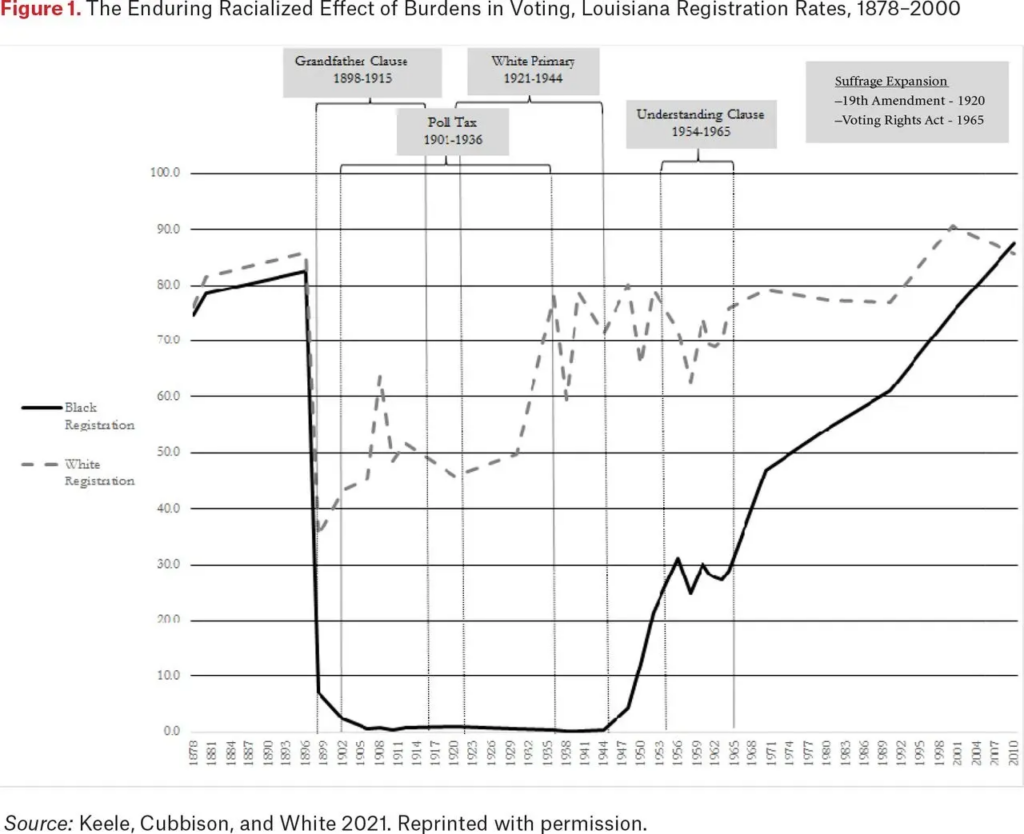
Regarding the graph, Moynihan observes:
In a single image, it tells the story of political power and discrimination. Black voters had power, briefly, then it was taken from them. A series of policies that were more or less explicit in their discriminatory purpose worked as intended, disenfranchising Black voters, and some poor White voters along the way.
This ended with the Voting Right Act of 1965, which removed the ability of governments to put in place facially neutral but clearly discriminatory practices, and in doing so ratcheted up Black registration in Louisiana until it matched White voters. This effect was immediate and enduring across the South.
While violence and intimidation were widespread during the Jim Crow era ( just months before passage of the VRA the country witnessed the bloody clash at the Edmund Pettus Bridge), election law was often enough to keep Black folks from registering. And note that the practices that disenfranchised Black voters during the Jim Crow era were represented as color-blind; in Moynihan’s words, they were “facially neutral but clearly discriminatory practices.” Poll taxes, literacy tests, exams assessing good character, property requirements, and so on were effective instruments in the hands of state officials who wished to preserve White rule.
The decades-long crusade of John Roberts
When a young John Roberts wrote the memo quoted above, he was the Reagan administration point person to defeat an amendment to the VRA. A 1980 Supreme Court opinion (City of Mobile v. Bolden), a 6-3 ruling with the Republican justices constituting the majority, had overruled an appellate court decision that the VRA rendered a gerrymandered district map (icing out Black representation) illegal. The SCOTUS majority, in overturning this decision, held that “action by a State that is racially neutral on its face violates the Fifteenth Amendment only if motivated by a discriminatory purpose.”
Congress, granted the power to enforce the Fifteenth Amendment by Section 2 of that amendment, did not agree. Roberts and the Reagan White House lost that battle. The 1982 legislation — passed with bipartisan support and signed into law by President Reagan — clarified that states were prohibited from introducing voting procedures with discriminatory effect.
But Roberts stayed the course. It was his “life’s work,” as Hasen noted. The Roberts Court has chipped away at the VRA in decision after decision. Finally, more than four decades after that initial defeat, Roberts has finally succeeded in demolishing the VRA. Sam Alito wrote the 6-3 decision in Louisiana v. Callais, powered by the Republican supermajority on the court.
Elena Kagan dissents
In the opening paragraphs of her dissent (joined by justices Sotomayer and Jackson), Justice Kagan offers a hypothetical illustration to clarify what’s at stake:
Consider the story of a hypothetical congressional district in a hypothetical State, subjected to a redistricting scheme. The example is admittedly stylized, but in its essence simulates the dispute before us, and clarifies the immense issues at stake. The district, let’s say, is a single county, in the shape of a near-perfect circle, sitting in the middle of a rectangular State. The State is one with a long history of virulent racial discrimination, and its many effects, including in residential segregation and political division, remain significant even today. The population of the circle district is 90% Black; the rest of the State, divided into five surrounding districts, is 90% White. And voting throughout all those districts is racially polarized: Black residents vote heavily for Democratic candidates, while White residents vote heavily for Republicans. The circle district thus enables the State’s Black community to elect a representative of its choice, whom no neighboring community would put in office. But that arrangement, in this not-so-hypothetical, is not to last. The state legislature decides to eliminate the circle district, slicing it into six pie pieces and allocating one each to six new, still solidly White congressional districts. The State’s Black voters are now widely dispersed, and (unlike the State’s White voters) lack any ability to elect a representative of their choice. Election after election, Black citizens’ votes are, by every practical measure, wasted.
That is racial vote dilution in its most classic form. A minority community that is cohesive in its geography and politics alike, and that faces continued adversity from racial division, is split—“cracked” is the usual term—so that it loses all its electoral influence. Members of the racial minority can still go to the polls and cast a ballot. But given the State’s racially polarized voting, they cannot hope—in the way the State’s White citizens can—to elect a person whom they think will well represent their interests. Their votes matter less than others’ do; they translate into less political voice. Or, as this Court put it recently, the cracking makes “a minority vote unequal to a vote by a nonminority voter.”
That’s pretty clear, isn’t it? Cracking districts creates two tiers of voters. The first tier dominates the second. Votes cast by the dominate group count. Votes cast by the disadvantaged group are, as Kagan writes “by every practical measure, wasted.”
Cracking a district is simpler than ever before with today’s computers. Denying fair representation to Black voters — so their votes matter less than others’ — is a snap. Congress, Kagan continues, chose to remedy this inequality by passing the Voting Rights Act. And by renewing it again and again. Congress made such unfairly apportioned legislative districts illegal because of the sordid history of voter suppression.
Even after the Fifteenth Amendment banned racial discrimination in voting, state officials routinely deprived African Americans of their voting rights. Through a seemingly boundless array of mechanisms—most of them facially race-neutral and among them the drawing of district lines—States either prevented Black citizens from casting ballots or ensured that their votes would count for next to nothing. The Voting Rights Act was meant as the corrective. And when this Court construed it too narrowly—insisting that a person suing under Section 2 had to prove discriminatory intent—Congress amended the law so that it turned solely on discriminatory effects. . . . And for 40 years now, this Court has recognized that language to encompass districting decisions that, in the way illustrated above, result in vote dilution—the “minimiz[ing]” of minority voters’ “ability to elect their preferred candidates.”
But no longer.
No longer. Not with the Roberts Court, especially not now that there is a Republican supermajority on the court.
The Republicans in power abhor multiracial democracy
The vision of the Roberts Court is at odds with the Reconstruction amendments to the Constitution and with the authority of Congress to pass legislation to enforce those amendments. This is a court that adamantly opposes multiracial democracy. The Republican justices prefer a return to an earlier time when the domination of White folks was unquestioned and the Black community was kept in its place. The court’s vision is akin to the Jim Crow era, which was ushered out by the civil rights revolution of 1960s America.
This Supreme Court majority is intent on turning back the clock, as implied by Donald Trump’s divisive invocation, Make America Great Again. This corruptly partisan majority has, often in brazen defiance of the Constitution and the rule of law, aggressively sought to impose its vision on the country.
John Roberts pledged at his confirmation hearing, “I will remember that it’s my job to call balls and strikes and not to pitch or bat.”
That’s hardly how things have worked out during his tenure as chief justice. Roberts has pushed the court toward the MAGA vision as much as the Republican justices in the majority have permitted him. The contrast between word and deed, especially during the Trump era, has been dramatic. Either Roberts was being disingenuous. Or he has had a massive change of heart since Ginsburg’s death, the unscrupulous maneuvers in the Senate, and the resulting 6-3 Republican supermajority (with no more Souters among them).
What was evident (though many observers deferred judgment of what they were witnessing in order to give Roberts and the Republican majority the benefit of the doubt) before 2020 — that partisan preferences, not the Constitution or the rule of law move these justices — has become unmistakable.
This is a court that is committed above all else to advancing the interests of the contemporary Republican Party. Disenfranchising Black voters is a priority of the national party in order to retain political power. The Roberts Court has proven willing, again and again, to enable the MAGA GOP in the quest for political domination.