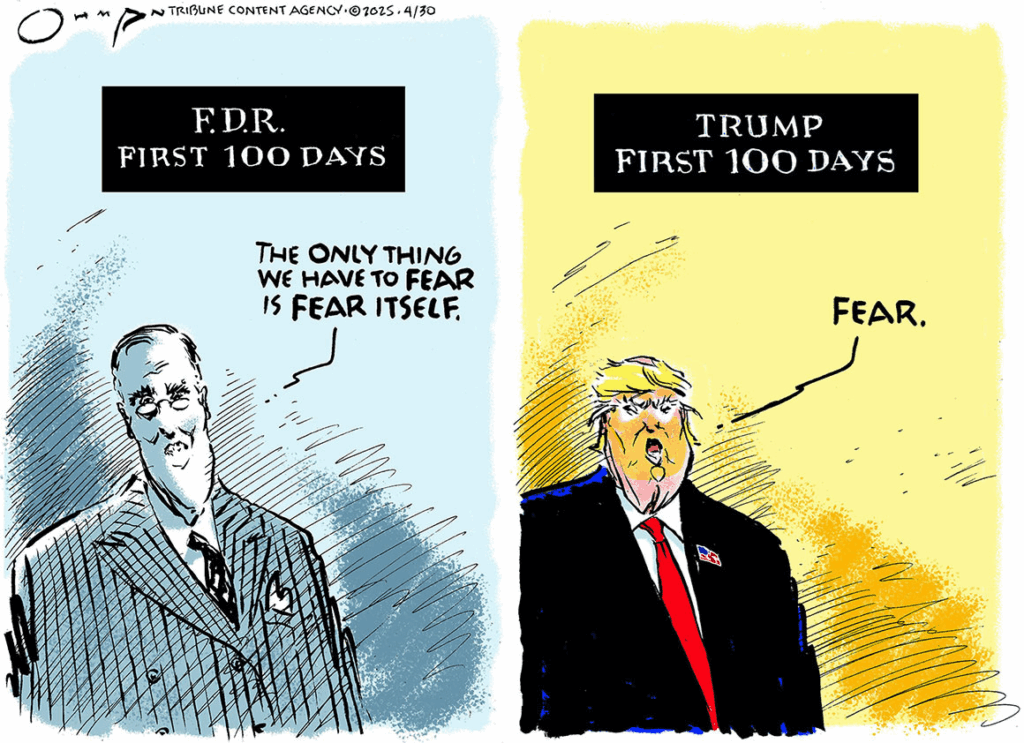
[Cartoon by Jack Ohman via Politico.]
From the assessment of Donald Trump’s first hundred days (2025 version) by Michael Wilner of the Los Angeles Times:
The concept of marking a president’s first 100 days originated with Franklin Delano Roosevelt, who used it as a goalpost to push through an extension of government employment to hundreds of thousands of Americans, and to work with Congress to pass over a dozen pieces of landmark legislation.
“The bookend to that seems to be Trump, whose focus has been on dismantling things,” said David Ekbladh, a history professor at Tufts University and author of “Look at the World: The Rise of an American Globalism in the 1930s.”
“Trump is asserting a particular theory about executive power, but that’s really all he has,” Ekbladh said, “and that has defined his first hundred days — disrupt, break, defund.”
Well, yeah, what we have seen is mostly “disrupt, break, defund,” but there is a particular logic to the destruction: it is (as Wilner suggests) targeted:
On March 17, Inter-Con, a Pasadena-based security firm, faced a stark choice that would later be documented in court filings: Allow staff from Elon Musk’s government efficiency program into the U.S. Institute of Peace, or face the elimination of its federal contracts. The firm relented. What had been an independent, congressionally funded agency was overrun.
It was a common scene unfolding across Washington throughout Trump’s first days back in power. Under Trump’s direction, Musk’s workers had already infiltrated much of the federal government in a lightning operation designed to overwhelm. The first marked for cuts were aid workers, educators, scientists, researchers, refugee officers and other civil servants who had served across Democratic and Republican administrations. The very notion of an independent government workforce had become the target.
And not only is independent government the target, so too are independent institutions across the country (and the globe): universities, scientific labs and research projects, hospitals, law firms, humanitarian and human services organizations, media outfits, cities, states, and more. Trump has signed executive orders targeting individuals (such as Chris Krebs, for telling the truth about the 2020 election) and Act Blue (part of the infrastructure for funding the opposition political party) for federal investigations.
The corruption of the Department of Justice (as well as Homeland Security, Treasury, and other departments) and the Trump pardons of criminals across the country have been as visible as they are shameless. That visibility is essential for the MAGA project to instill fear: to raise the cost of opposing the autocrat in the White House and his cronies.
Meanwhile, the president — while expressing doubt about the right of Americans to due process, enshrined in the Fifth Amendment — clearly has no qualms about veering from the Constitution and the rule of law.
Observations
A. The Authoritarian Playbook: The Trump2 administration is moving furiously, relentlessly to squelch institutions, groups, and individuals with the capacity to act independently in opposition to MAGA/Republican domination. Trump’s threats and transgressions are raising the cost of standing up to him. This is exactly what scholars of authoritarianism predicted before Trump began his second term — that he would wage a war on civil society and his political opposition. In December, Steven Levitsky dismissed a Putin-style takeover:
But what I think has gotten insufficient attention among Americans is the centrality of simply politicizing the state and deploying it in ways not only to punish rivals, but also to change the cost-benefit calculation of actors across the political spectrum and throughout civil society so that they have an incentive to sort of step to the sidelines. And so, you know, first and foremost, we’ve been told to expect that the Department of Justice will be wielded to punish those who have tried to hold the Trump administration accountable. I think we’ll see it wielded against some politicians. We’ll see it wielded against some businesspeople. We’ll see it wielded against some civil society leaders. We may see it wielded against Harvard and other elite universities.
So I think this government will, far more than the first Trump administration, politicize key state agencies and wield them in ways that raise the cost of continued opposition. There may be a handful, dozens, of exemplary cases, but those cases have the potential to signal to thousands and thousands of other people that it’s just not worth engaging in politics the way they used to before. And so, young lawyers will not jump into politics, but rather stay in the law firm. Young journalists will decide to stick to the sports beat rather than cover politics. Young CEOs will decide that it’s better just not to donate to the Democratic Party. It’s very difficult to gauge how consequential that will be, but that tilting of the playing field is coming.
B. The Cruelty is the Point: Elon Musk, Russell Vought, and Donald Trump have gleefully embraced DOGE’s rampage, which has resulted in great harm to Americans inside and outside of government. Vought has celebrated inflicting harm:
“We want the bureaucrats to be traumatically affected,” he said. “When they wake up in the morning, we want them to not want to go to work because they are increasingly viewed as the villains. We want their funding to be shut down so that the EPA can’t do all of the rules against our energy industry because they have no bandwidth financially to do so.
“We want to put them in trauma.”
C. Wreaking Havoc: The goal is to tear down not just institutions, but the fabric of life of people who oppose MAGA. Trump is seeking, in Franklin Foer’s words, “to crush the power and authority of whole professions, to severely weaken, if not purge, a social class.”
The target of the administration’s campaign is a stratum of society that’s sometimes called the professional managerial class, or the PMC, although there’s not one universal moniker that MAGA applies to the group it is now crushing. That group includes society’s knowledge workers, its cognitive elite, the winners of the tournament that is the American meritocracy. It covers not only lawyers, university administrators, and professors, but also consultants, investment bankers, scientists, journalists, and other white-collar workers who have prospered in the information age.
Further:
Animosity to the PMC is a propulsive force in Trump’s second term. Rather than merely replacing its ideological foes—by installing its own appointees in federal agencies—the administration is bent on destroying their institutional homes, and the basis for their livelihood.
D. The Enemy Within: Authoritarians must always create an internal enemy to oppose. There must be an Us vs. Them. The right (even before MAGA), in Foer’s words, “zeroed in on the PMC as the enemy within.”
Us vs. Them has been a consistent theme of Donald Trump. He has never embraced the country as a whole. At the beginning of his first term in 2017, when we weren’t sure what would transpire, this much was clear. He did not intend to represent the whole country in its breadth and diversity. MAGA’s ‘real Americans’ excludes much of America.
From Rush Limbaugh to Newt Gingrich to Fox News Channel, the right has demonized nearly half of the country. Enemies of America, in this view, must be crushed. Trump’s MAGA base — perhaps 40% of the country — has been coached to hate and fear the other.
With the advent of Trump2, the MAGA Republican Party has control of all three branches of the federal government. We’re living with the result.
Fear
For those of us outside of MAGA, Trump’s message is: Fear. Fear me. Fear the federal government. Fear the true believers and even the violent criminals willing to act on my behalf.
We have every reason to take heed.