Those who cannot remember the past are condemned to repeat it.
Last week, Daniel Ziblatt (“Warning From Weimar: Why Bargaining With Authoritarians Fails”), reviewing a series of “catastrophic miscalculations—each rooted in short-term maneuvering and self-justification—[that] paved the way for Hitler’s ascent,” draws some lessons for the United States in 2025. “The collapse of the Weimar Republic was not inevitable.” It came about only after mainstream politicians thought they could contain or outmaneuver or compromise with Hitler.
No democratic constitution is self-enforcing, not even ones much older than the Weimar Republic was in the early 1930s. Citizens and leaders must defend democratic institutions whenever they are threatened and whatever the scale of the threat.
…
Democracy rarely dies in a single moment. It is chipped away via abdication: rationalizations and compromises as those with power and influence tell themselves that yielding just a little ground will keep them safe or that finding common ground with a disrupter is more practical than standing against him. This is the enduring lesson of Weimar: extremism never triumphs on its own. It succeeds because others enable it—because of their ambition, because of their fear, or because they misjudge the dangers of small concessions. In the end, however, those who empower an autocrat often surrender not only their democracy but also the very influence they once hoped to preserve.
Trump’s America 2025
Is there a lesson in the Weimar history that resonates in the United States today? Plenty of observers (especially political scientists who have studied democratic decline) think so.
Norman Ornstein (“Our guardrails are failing us”) looks at “the brutal reality in America” today:
The movement of National Guard troops and armored vehicles into D.C. has nothing to do with an imaginary violent crime wave—underscored by the fact that the troops are generally nowhere near the areas where crime is more prevalent. It is a beta test for using the military to suppress dissent and intimidate political opponents and to create the conditions for invoking the Insurrection Act, suspending elections, and declaring martial law, backed by military force.
Meanwhile, critical entities of government have been blown up, public safety and national security are endangered, and the rule of law is in shambles as the federal government is used to intimidate and punish Trump’s adversaries and those whose policies he does not like; illegal rescissions eviscerate programs lawfully appropriated and authorized by Congress; and we’re witnessing a level of presidential corruption far greater than in every administration in history combined. Every characteristic of an authoritarian regime—from shaking down law firms and universities to hijacking culture to trying to erase and rewrite history to undermining free and fair elections—is underway.
Note Ornstein’s fear that Trump might suspend elections. In December 2024, Ziblatt (with co-author Steven Levitsky) surveyed the authoritarian threat posed by Trump. Things look much worse now than they did last December. Ziblatt voiced concerns about Trump “going after the democratic opposition in ways that undermine competition. So it’s not about changing the rules, but really attacking civil society, attacking the opposition.” Trump has attacked civil society and the opposition; has tried to undermine electoral competition; and has also sought to change the rules on elections and reapportionment. Ornstein’s fear is more credible in September 2025 than it would have been last December.
Yet, as Ornstein notes, the business community, Republicans in the House and the Senate, the press, the billionaires who own media outfits, the Republican majority on the Supreme Court, and other institutions and individuals are either celebrating or shrugging their shoulders at what Trump is up to or just lying low to make the best of things.
It is unnerving for Democrats (who regard themselves defenders of democracy) how meager the resistance to Trump’s authoritarian moves has been. Civil society has proven to be more of a pushover, than a bulwark.
Ed Kilgore has recognized how far we’ve come (“Democrats Can’t Afford to Ignore Trump’s Creeping Fascism”) in the first few months of Trump’s second term. He suggests that Democrats cannot overlook Trump’s “criminal lawlessness” going forward (even if warnings about Trump’s “threat to democracy” didn’t resonate in 2024):
Trump no longer represents a prospective “threat to democracy” who might fail to follow through on his thuggish authoritarian rhetoric, just as he often did during his amateurish first term. Depending on how you view his trajectory, he poses at the very least an imminent danger to democracy and is arguably in the process of converting America into an authoritarian regime. Nearly every step he has taken since last November, from building an administration stuffed with MAGA shock troops, to relentless, almost hourly claims of new presidential turf, to unprecedented assaults on private businesses and universities, to the rapid development of a national police force, shows that something like Viktor Orban’s Hungary — formally still a democracy, but under rigid one-party control — is Trump’s goal.
In that scenario, competitive authoritarianism, Trump might undermine free and fair elections without actually calling them off. He has tried a version of this, culminating in January 2021, and has continued to cast doubt on the legitimacy of elections whenever the result might go against him.
And that’s not the half of it. As each of our critics have noted, Trump’s lawless, unconstitutional assaults have hardly been confined to undermining democratic elections.
What we’ve witnessed isn’t close to normal. Not close to the rule of law or to the Constitution as jurists and scholars have regarded it for decades. Not close to traditional views of checks and balances and a limited presidency.
A divided nation
And yet, most Americans are hardly in an uproar about what’s going on. Seven months into Trump’s (second) first year, the country couldn’t be more divided.
Consider this Gallup poll (August 2025):
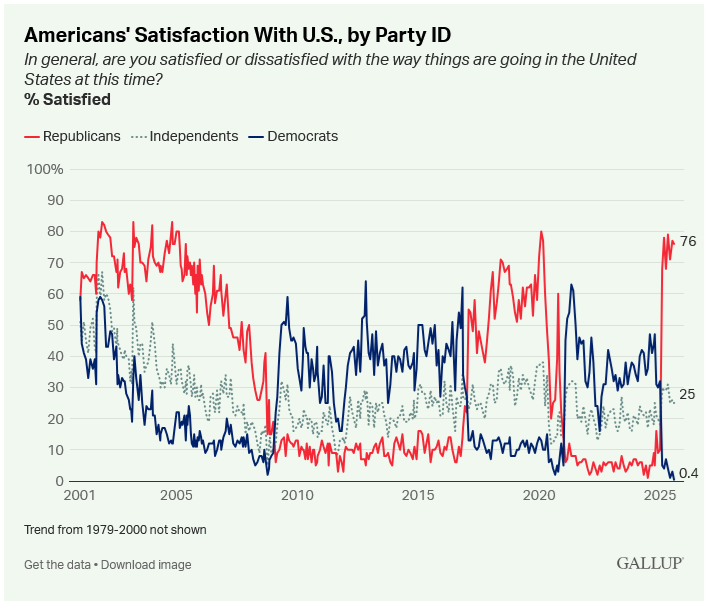
Three-quarters of Republicans — 76% — believe things are going well enough. They are fine with Trump’s autocratic rule. While only 0.4% of Democrats are pleased with the country’s direction, as are 25% of Independents.
In a polarized era, perhaps this isn’t surprising. But it’s scary that perhaps a third of the country is prepared to reject (what I regard as) traditional democratic rules and norms.
Our democracy is in trouble.