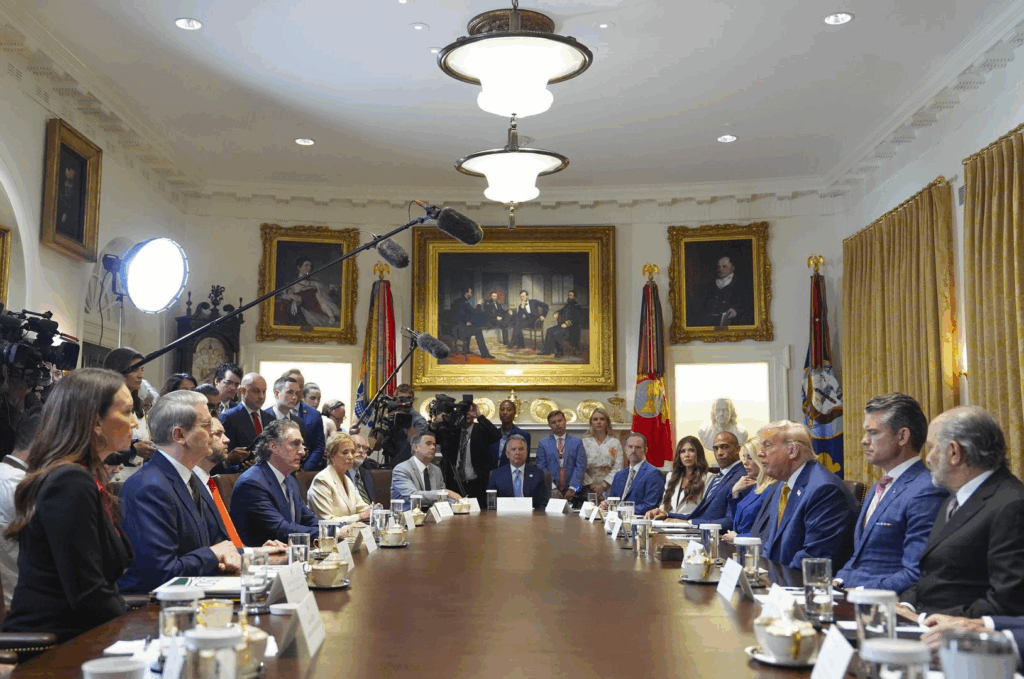
[Trump cabinet meeting – screen grab from AP video]
It was a cabinet meeting unlike any other in American history. It was very long — all three hours and seventeen minutes of the spectacle were televised — and brimming with extravagant praise for the MAGA leader. While such stuff would not be at all unusual in foreign regimes headed by dictators, this one was all American. In the Cabinet Room of the White House.
The meeting … bore similarities … to meetings of ministers in other countries where leaders have sought to exert strong, personal control over large stretches of national life, scholars said, including in Russia and Turkey. . . .
“It is definitely a widespread phenomenon with a lot of these personalist leaders,” said Andrea Kendall-Taylor, the director of the Transatlantic Security Program at the Center for a New American Security and a former intelligence analyst in the first Trump administration focused on Russia.
. . .
Nearly all presidents receive some flattery from their subordinates. The profuse nature of the praise for Trump, however, bore similarities to other countries where public displays of obedience are prized above all, Kendall-Taylor said.
Trump “is like the great puppet master that’s making all the things dance and therefore work for the country,” she said. “This is just such a clear display that loyalty and fealty is the number one currency.”
There in the Cabinet Room — which is starting to take on the gilded-cage look of Mr. Trump’s Oval Office — all of the president’s men and women took their turns, each working a little bit harder than the last to offer Mr. Trump praise and to assure him that they were working to tackle his long list of grievances.
That list is as ever-growing as it is specific to Mr. Trump’s pet peeves and political ambitions. It includes preventing “transgender for everybody” in American sports; using a heavy hand — perhaps the death penalty, the president said — to crack down on violent crime; the ongoing threat of windmills; the foul state of traffic medians; the speed with which water flows; and the attempts at securing peace deals for as many as seven international wars, a number that seems to grow by the day.
Jan Psaki featured two minutes of the flattery (beginning at 1:38 when she says), “This is one of those things you really have to see for yourself.” See for yourself:
Henry Farrell, drawing on the work of another political scientist, Xavier Marquez (who coined the term “inflation flattery”), observes “Grotesque self-abasement can be entirely rational.” Farrell (with quotations from Marquez):
Marquez suggests that flattery becomes increasingly ridiculous when competition for rewards intersects with the dynamics of signalling personal loyalty.
loyalty signaling typically emerges when there is common knowledge that there are rewards or punishments arising from credibly and publicly recognizing (or failing to recognize) the leader’s exceptional qualities
If you are in a cult of personality centered on someone who has power, you want to reap the benefits of connection rather than suffering the penalties of disfavor. So how do you show your loyalty? By paying the costs of humiliation. The more grotesquely over the top your praise, the more credible it is as a signal of support for Dear Leader.
Voluntarily engaging in behaviours that incur peer disapproval or loss of dignity can credibly indicate one’s loyalty, as when people repeat obviously absurd flattery of the leader in public.
Apparatchiks’ willingness to degrade themselves will hurt their reputation with other people. But for exactly that reason, it serves as proof of loyalty to the one man who counts, Donald Trump. The more appalling the self-abasement, the more effectively it will serve this purpose.
All hail the transformational president

Trump’s “big, beautiful face on a banner in front of the Department of Labor.”
The man (if we can believe what we hear) has made Americans safer and America more secure. He has brought the American dream back to life, revived all industries that were once lost, will save the whale on the East Coast, and has already saved college football. Huzzah!
- “You have brought us back from the edge. You have the overwhelming mandate from the American people.”
- “This is the greatest cabinet working for the greatest president.”
- “There’s only one thing I wish for—that the Nobel committee finally gets its act together and realizes that you are the single finest candidate since this Nobel award was ever talked about. Your success is game-changing out in the world today, and I hope everybody wakes up and realizes that.”
This is flattery hyperinflation. In Donald Trump’s executive branch, it is not knowledge or competency or a commitment to serving the country that matters — but loyalty to one man.
The folks in his cabinet know what’s up. Like presidents, prime ministers, diplomats, and CEOs across the globe, they know how susceptible to fawning flummery Donald Trump is. They understand the man. They understand the MAGA base. They understand the Republican media bubble. They are more than willing to play their parts.
And they will say just about anything to establish their loyalty.
Donald Trump expects no less.
[For those interested: a simple Google search brings up links to free PDFs of The Mechanisms of Cult Production by Xavier Márquez.]