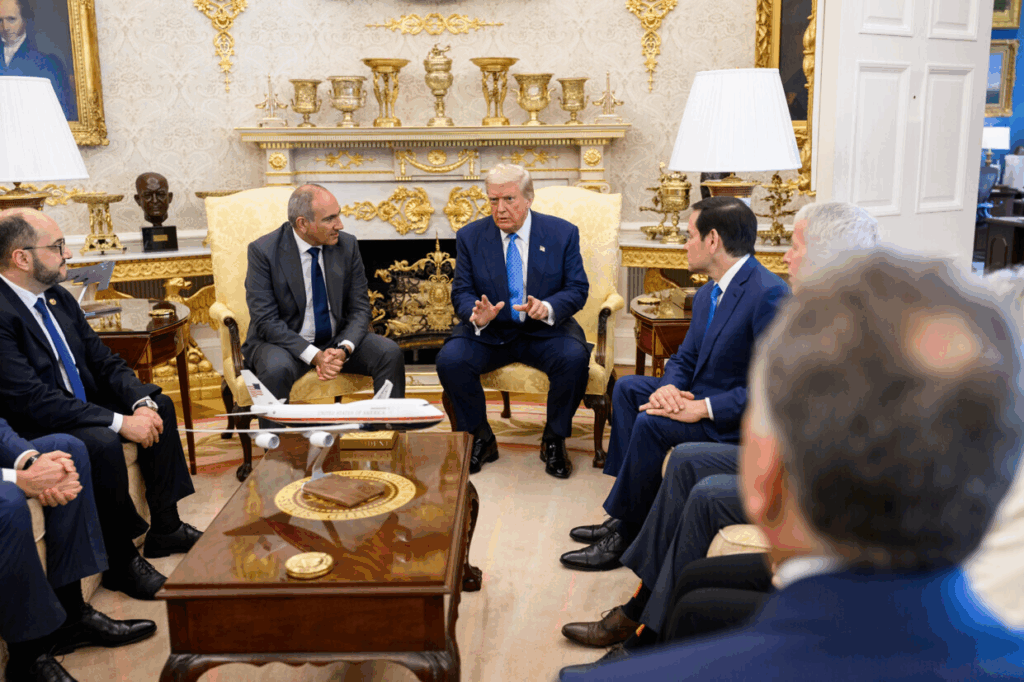
Photo from Donald J. Trump Truth Social.
He has paved over the Rose Garden, erected a pair of 88-foot flagpoles, and plans a $200 million 90,000-square foot project to place a ballroom atop the East Wing — almost doubling the size of the White House. And there’s more gold by the day.
Update: A May 27 op-ed by Emily Keegin in the New York Times (“Trump’s Oval Office Is a Gilded Rococo Nightmare. Help.”) offers more substantive commentary, history, photographs, and even a six-second GIF from a movie featuring Trump’s apartment.
In 2017 the journalist Peter York called Mr. Trump’s aesthetic “dictator chic,” likening his New York penthouse to Muammar el-Qaddafi’s homes. Others have looked further back in history for an analogue. Many concluded not only that Mr. Trump’s style is the stuff of kings and despots but also that it’s French.
On one level, they aren’t wrong. The decoration Mr. Trump has splattered across the Oval Office is inspired by European Baroque and Rococo of the 1600s and 1700s, when power was shown through ornate displays of grotesque abundance. Gold leaf moldings and large mirrors filled Baroque palace walls from Versailles to the Peterhof Palace. But in the early 1700s Rococo, an even gaudier style distinct for its asymmetry, swirling tendrils and gilded seashells, was born. Often criticized for being purely decorative and intellectually vacuous, it would become a perfect visual metaphor for the European royal courts of the 18th century: unserious people draped in gold baubles and ruffled pastels.