And our democratic institutions are eroding.
The world’s billionaires have always been rich and powerful—but never more than now. That’s particularly true in the United States, where Donald Trump was sworn in (again) as America’s billionaire-in-chief in January. This time around, he’s giving the billionaire class more control over the government than ever before. His right-hand man is the planet’s richest person. His administration includes at least ten billionaires and billionaire spouses. And scores of billionaire execs—from Meta’s Mark Zuckerberg to French luxury goods kingpin Bernard Arnault—have lined up behind Trump.
— Forbes’ 39th Annual World’s Billionaires List (April 1, 2025)
The United States, with 902 billionaires, leads every other country in the world. (China is second at 516.) And increasingly the American billionaires have begun pouring enormous sums into politics, as the Washington Post reports:
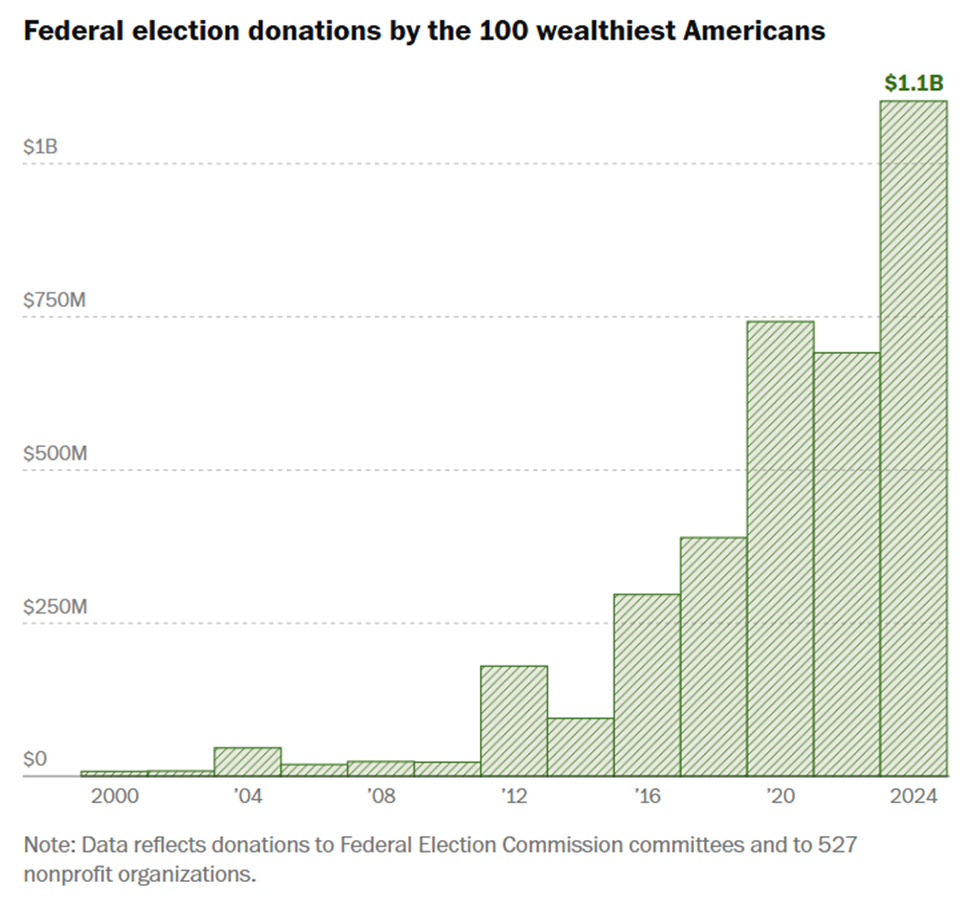
In an era defined by major political divisions and massive wealth accumulation for the richest Americans, billionaires are spending unprecedented amounts on U.S. politics. Dozens have stepped up their political giving in recent years, leading to a record-breaking surge of donations by the ultrarich in 2024. Since 2000, political giving by the wealthiest 100 Americans to federal elections has gone up almost 140 times, well outpacing the growing costs of campaigns, a Washington Post analysis found.
In 2000, the country’s wealthiest 100 people donated about a quarter of 1 percent of the total cost of federal elections, according to a Post analysis of data from OpenSecrets. By 2024, they covered about 7.5 percent, even as the cost of such elections soared.
We can thank — first and foremost — the Roberts Court, beginning with Citizens United (2010), with this political state of affairs. In his opinion for the court, Justice Anthony Kennedy concluded that “independent expenditures, including those made by corporations, do not give rise to corruption or the appearance of corruption.” There is ample reason to disagree emphatically on both counts.
Billionaires are apt to differ with me, of course, as the following quotations from the WaPo piece suggest.
John Catsimatdis of New York City:
“If you’re a billionaire, you want to stay a billionaire,” said Catsimatidis, whose net worth is estimated at $4.5 billion. It’s not just about his own wealth, he said, adding, “I worry about America and the way of life we have.”
Marc Shuster (“a Miami-based lawyer who represents multimillionaires and billionaires”):
“They think the left has been taken over by Zohran Mamdanis,” Shuster said, pointing to the newly elected Democratic socialist mayor of New York. “I think they’ve shifted because a Democratic Party that used to stand for the working class is now immersed in gender ideology.”
And:
“The progressive left of the Democratic Party is a socialist party,” said Thomas Peterffy, who founded an electronic brokerage firm and has a net worth of $57.3 billion, speaking from one of his homes in Aspen, Colorado. “The wealthiest people are business people, and they are surging to Trump because they understand how much better Trump is for a prosperous economy.”
Consider “the life we have.” You and I? Or the billionaires? Regarding “how much better Trump is for a prosperous economy,” the U.S. economy is flourishing, but can that justify the vast chasm, growing ever wider, between the billionaires and the rest of us? And, it’s because they think “the working class” has been deserted by the Democratic Party and Zohran Mamdani, that the billionaires have begun buying elections and political influence, while funneling payoffs to Trump and other MAGA grifters? An appeal to Occam’s razor casts doubt on this conjecture.
In the past ten months, I’ve observed many times — in conversation, not in this blog — that our elites have failed us. That was in reference to the leaders of influential institutions of civil society — media companies, law firms, universities, the opposition political party, and so on. There has been altogether too much “anticipatory obedience” (in Timothy Snyder’s words), not nearly enough pushback (though things have begun to change recently).
Quinta Jurecic has observed (of institutions) that “generally speaking, and with the glaring exception of november 2024, the more directly democratic an institution has been, the better it has checked Trump (eg grand and petit juries); the more elite and insular, the less effective (the Senate, the Supreme Court, big business).” Something analogous is, generally speaking, true of income and wealth: the more riches, the fewer objections to democratic backsliding. Just compare the Americans at the No Kings protests, or casting ballots this month, with the craven billionaires referenced in the quotation that leads this post.
Can we just call them oligarchs? [tə-māʹtō, tə-mäʹtō]
Josh Marshall observes that the billionaires are “becoming increasingly class conscious.”
It’s always been true that money buys influence in American politics. In some ways, it was even greater and more brazen in the past since there wasn’t even the pretense of limits on giving or disclosure.
But the role of billionaire ownership of the political process has not only grown rapidly in recent years. Public recognition of that fact has, too, which has — perhaps paradoxically or perhaps not — spurred the drive for even tighter ownership. It’s no exaggeration to say that the deca-billionaire or even centi-billionaire class — setting aside those who might command a mere few billion dollars — act now as a kind of post-modern nobility, a class which does not rule exclusively but interacts with politics in a fundamentally different way from the rest of society.
It’s not just that the folks in the upper echelon of the top 1-percent are loathe to defend democratic institutions; they are determined to use their enormous wealth to get their way even at the cost of trashing the guardrails that preserve our democracy. They are playing politics in a fundamentally different way than the rest of us. Moreover, far too many in the billionaire class are prepared to abandon democracy altogether. They identify as billionaires and (for the many convinced that they have a right to rule) as oligarchs.
The billionaire class is a threat to every American who wishes to preserve our democracy.