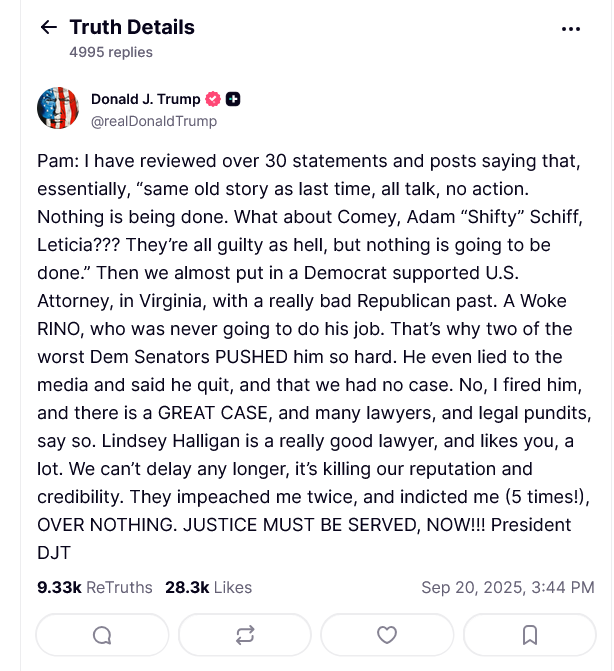
In a social media post (that may have been intended as a DM to the Attorney General of the United States), Donald Trump directs AG Pam Bondi to prosecute three political opponents immediately!
Complaining about the
“same old story as last time, all talk, no action. Nothing is being done. What about Comey, Adam “shifty” Schiff, Leticia??? They’re all guilty as hell, but nothing is going to be done.”
The mainstream media has characterized Trump’s Department of Justice going after his political enemies as veering from DOJ norms established after Watergate. That was a half-century ago. But the norm for DOJ (and for presidents) goes much further back, as Jonathan Bernstein notes:
I’ve seen a bunch of people refer to Trump violating post-Watergate rules about interference with the prosecutions, but don’t be fooled by that. Those practices only formalized what people always thought was supposed to be happening all along. We know this because (1) Nixon hid what he was doing, and (2) when Nixon’s interference with the Justice Department was exposed, everyone basically freaked out.
Until this lawless president and the Roberts Court’s Republican-majority opinion (unmoored from well-established legal scholarship, judicial precedent, and a plain reading of the Constitution) in Trump v. United States, no one thought that DOJ or U.S. presidents operated this way. (In other nominally democratic countries, with autocratic leaders amassing control, yes.)
This is an unleashed wannabe authoritarian bullying our nation. We’ve never seen anything like it. Not in our country. Not on this scale. Not right out in the open. Not until Trump and the Roberts Court (and a supine Republican Congress) made it happen.
In the ten days since my last post, Charlie Kirk, co-founder of Turning Point USA, was shot and killed. This is a tragedy for Kirk’s family (including two children so young they will have few memories of their father) and friends (including a number close to the White House).
It is also a severe blow to American democracy. Murder is wrong. Political violence, with its pervasive, malignant consequences, compounds the calamity.
I know more about Kirk today than I did a week ago, when I recognized his name just because of his affiliation with Turning Point USA. I was especially distressed to hear of his assassination because it is another mark of our democratic decline at a perilous time. And it brought to mind something I’d read a day earlier in Timothy Shenk’s Left Adrift: What Happened to Liberal Politics.
The passage resonated for me when I heard of Kirk’s death. Shenk relates an experience of Democratic political consultant Stan Greenberg, who was practicing his craft in Israel. Emphasis added:
The relentless pressure of Israeli politics was like nothing Greenberg had experienced before. It could be exhilarating, especially when you could leave it behind with a flight back home. But he thought voters were sick of it. After spending time in the country, Greenberg came to one overarching conclusion: “Israelis longed to be normal.” The subjects that came up in conversations with voters were the same ones he had seen with focus groups in the US and UK—jobs, schools, pensions. “Normal things,” Greenberg said. “That’s all they wanted.”
The US and much of the world in the more than two decades since Greenberg’s observation have by now become more like Israel. We are no longer normal, as Shenk noted within a dozen pages: “Wars for the national soul were breaking out across the globe. Israel wasn’t the exception. It was just ahead of the curve.”
Normal politics is essential for democracy. A whole bunch of stuff is required to make our democratic institutions work: respect for folks who disagree with us; acknowledging the legitimacy of their participation; and adhering to democratic rules of the road to guide our safe passage. Intense polarization, a closely divided nation, and fierce tribal loyalties crowd out what, until a couple of decades ago, was normal.
Without spelling out in detail the conditions and constraints of normal politics, it is clear that violence is antithetical to the enterprise. Bargaining, compromise, the willingness to accept half a loaf at times, and the determination to engage in the process again in the future — all this represents the give and take of politics.
That’s the way it works when it works. When things are normal.
Violence shatters these possibilities. It’s distressing to live in a time when we are so far from normal.
Fourth Amendment: The right of the people to be secure in their persons, houses, papers, and effects, against unreasonable searches and seizures, shall not be violated, and no Warrants shall issue, but upon probable cause, supported by Oath or affirmation, and particularly describing the place to be searched, and the persons or things to be seized.
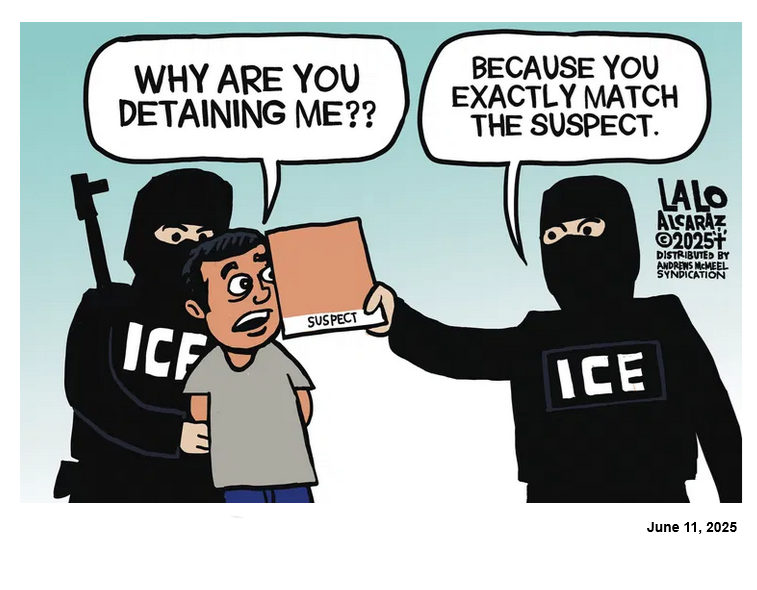
Ruling in favor of the Trump administration once again, the Roberts Court removed a stay placed by a district court that barred — until the district judge could decide the case on its merits — masked government agents from detaining anyone who looks Latino, speaks with an accent, and appears to have a low-wage job at (for instance) a car wash, Home Depot, or restaurant.
The majority offered no reason or explanation for its decision (Kristi Noem, Secretary, Department of Homeland Security, Et Al. v. Pedro Vasquez Perdomo, Et Al. On Application for Stay), though Justice Brett Kavanaugh offered a concurrence. Justice Sonia Sotomayer issued a written dissent (joined by Justices Kagan and Jackson). Her objections centered on the court’s abuse of the “emergency docket,” on the facts on the ground, and on judicial history regarding the Fourth Amendment:
During the raids, teams of armed and masked agents pulled up to car washes, tow yards, farms, and parks and began seizing individuals on sight, often before asking a single question.
The district court found that stopping individuals was unlawful because the basis for the stops failed to satisfy the Fourth Amendment’s requirement of reasonable suspicion.
Instead of allowing the District Court to consider these troubling allegations in the normal course, a majority of this Court decides to take the once-extraordinary step of staying the District Court’s order. That decision is yet another grave misuse of our emergency docket. We should not have to live in a country where the Government can seize anyone who looks Latino, speaks Spanish, and appears to work a low wage job. Rather than stand idly by while our constitutional freedoms are lost, I dissent.
In defiance of prior judicial decisions and the plain text of the Fourth Amendment:
The Government, and now the concurrence, has all but declared that all Latinos, U. S. citizens or not, who work low wage jobs are fair game to be seized at any time, taken away from work, and held until they provide proof of their legal status to the agents’ satisfaction.
She rejects Justice Kavenaugh’s claim (in his concurrence) that agents were merely engaging in “brief stops for questioning,” pointing to evidence that American citizens have been roughed up and hauled away.
They are seizing people using firearms, physical violence, and warehouse detentions. Nor are undocumented immigrants the only ones harmed by the Government’s conduct. United States citizens are also being seized, taken from their jobs, and prevented from working to support themselves and their families. … Countless people in the Los Angeles area have been grabbed, thrown to the ground, and handcuffed simply because of their looks, their accents, and the fact they make a living by doing manual labor. Today, the Court needlessly subjects countless more to these exact same indignities.
The Republican majority on the United States Supreme Court continues to make decisions consistent with the policy preferences of the justices and in favor of the leader of the MAGA Republican Party. As usual in its shadow docket rulings, it offers no written opinion explaining the majority view.
Those who cannot remember the past are condemned to repeat it.
Last week, Daniel Ziblatt (“Warning From Weimar: Why Bargaining With Authoritarians Fails”), reviewing a series of “catastrophic miscalculations—each rooted in short-term maneuvering and self-justification—[that] paved the way for Hitler’s ascent,” draws some lessons for the United States in 2025. “The collapse of the Weimar Republic was not inevitable.” It came about only after mainstream politicians thought they could contain or outmaneuver or compromise with Hitler.
No democratic constitution is self-enforcing, not even ones much older than the Weimar Republic was in the early 1930s. Citizens and leaders must defend democratic institutions whenever they are threatened and whatever the scale of the threat. … Democracy rarely dies in a single moment. It is chipped away via abdication: rationalizations and compromises as those with power and influence tell themselves that yielding just a little ground will keep them safe or that finding common ground with a disrupter is more practical than standing against him. This is the enduring lesson of Weimar: extremism never triumphs on its own. It succeeds because others enable it—because of their ambition, because of their fear, or because they misjudge the dangers of small concessions. In the end, however, those who empower an autocrat often surrender not only their democracy but also the very influence they once hoped to preserve.
Trump’s America 2025
Is there a lesson in the Weimar history that resonates in the United States today? Plenty of observers (especially political scientists who have studied democratic decline) think so.
The movement of National Guard troops and armored vehicles into D.C. has nothing to do with an imaginary violent crime wave—underscored by the fact that the troops are generally nowhere near the areas where crime is more prevalent. It is a beta test for using the military to suppress dissent and intimidate political opponents and to create the conditions for invoking the Insurrection Act, suspending elections, and declaring martial law, backed by military force. Meanwhile, critical entities of government have been blown up, public safety and national security are endangered, and the rule of law is in shambles as the federal government is used to intimidate and punish Trump’s adversaries and those whose policies he does not like; illegal rescissions eviscerate programs lawfully appropriated and authorized by Congress; and we’re witnessing a level of presidential corruption far greater than in every administration in history combined. Every characteristic of an authoritarian regime—from shaking down law firms and universities to hijacking culture to trying to erase and rewrite history to undermining free and fair elections—is underway.
Yet, as Ornstein notes, the business community, Republicans in the House and the Senate, the press, the billionaires who own media outfits, the Republican majority on the Supreme Court, and other institutions and individuals are either celebrating or shrugging their shoulders at what Trump is up to or just lying low to make the best of things.
It is unnerving for Democrats (who regard themselves defenders of democracy) how meager the resistance to Trump’s authoritarian moves has been. Civil society has proven to be more of a pushover, than a bulwark.
Ed Kilgore has recognized how far we’ve come (“Democrats Can’t Afford to Ignore Trump’s Creeping Fascism”) in the first few months of Trump’s second term. He suggests that Democrats cannot overlook Trump’s “criminal lawlessness” going forward (even if warnings about Trump’s “threat to democracy” didn’t resonate in 2024):
Trump no longer represents a prospective “threat to democracy” who might fail to follow through on his thuggish authoritarian rhetoric, just as he often did during his amateurish first term. Depending on how you view his trajectory, he poses at the very least an imminent danger to democracy and is arguably in the process of converting America into an authoritarian regime. Nearly every step he has taken since last November, from building an administration stuffed with MAGA shock troops, to relentless, almost hourly claims of new presidential turf, to unprecedented assaults on private businesses and universities, to the rapid development of a national police force, shows that something like Viktor Orban’s Hungary — formally still a democracy, but under rigid one-party control — is Trump’s goal.
In that scenario, competitive authoritarianism, Trump might undermine free and fair elections without actually calling them off. He has tried a version of this, culminating in January 2021, and has continued to cast doubt on the legitimacy of elections whenever the result might go against him.
And that’s not the half of it. As each of our critics have noted, Trump’s lawless, unconstitutional assaults have hardly been confined to undermining democratic elections.
What we’ve witnessed isn’t close to normal. Not close to the rule of law or to the Constitution as jurists and scholars have regarded it for decades. Not close to traditional views of checks and balances and a limited presidency.
Trump on deploying the National Guard to Chicago: "I have the right to do anything I want to do. I'm the president of the United States."
And yet, most Americans are hardly in an uproar about what’s going on. Seven months into Trump’s (second) first year, the country couldn’t be more divided.
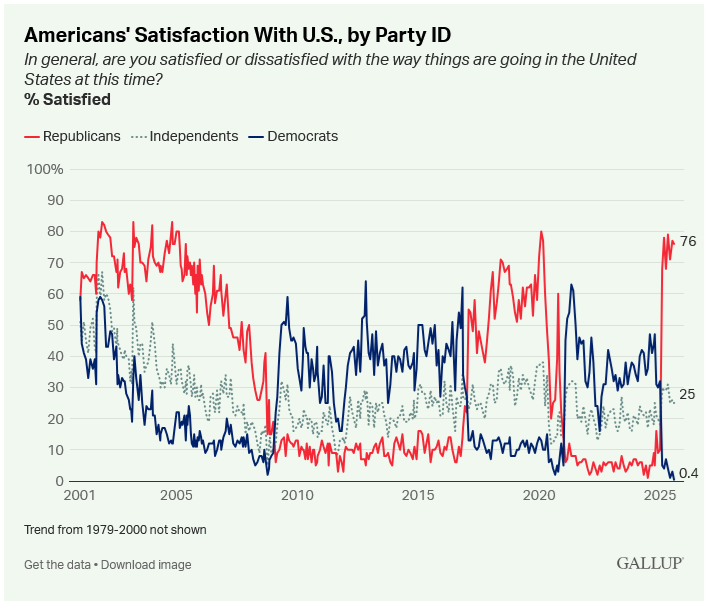
Three-quarters of Republicans — 76% — believe things are going well enough. They are fine with Trump’s autocratic rule. While only 0.4% of Democrats are pleased with the country’s direction, as are 25% of Independents.
In a polarized era, perhaps this isn’t surprising. But it’s scary that perhaps a third of the country is prepared to reject (what I regard as) traditional democratic rules and norms.